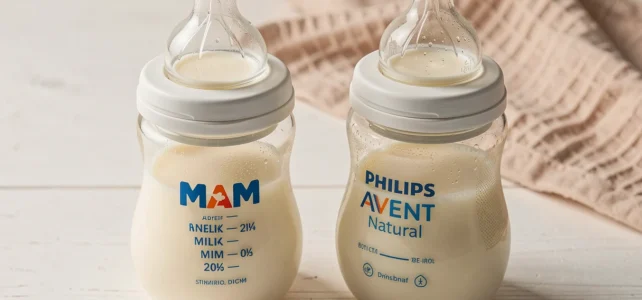
The choice between Mam and Avent is based on radically different feeding logics. Mam Easy Start Anti-Colic manages air circulation through the base of the bottle, while Philips Avent Natural Response conditions the flow of milk to the baby’s active sucking. Two philosophies, two meal experiences, and direct consequences on the breast-bottle alternation, colic management, and the child’s autonomy.
Ventilation through the base or anti-reflux valve: two distinct anti-colic mechanisms
Mam uses a ventilated base that separates the airflow from the milk flow. Air enters through the bottom of the bottle, circulates without crossing the liquid, which reduces the formation of bubbles and foam in the milk. The baby swallows less air during feeding.
Avent Natural Response works differently. The nipple incorporates an internal valve that prevents milk from flowing unless the baby is actively sucking. The anti-colic effect here relies on flow control rather than air management.
In practice, we observe that babies prone to significant gas colic often benefit more from the Mam system because the problem is addressed at the source (air in the bottle). For babies who swallow air due to a too-fast flow, the Avent valve corrects the issue better. The differences between Mam and Avent bottles thus depend as much on the infant’s sucking profile as on the technical specifications of the two systems.

Mam SkinSoft nipple vs. Natural Response nipple: impact on mixed feeding
The Mam SkinSoft nipple adopts a flat, anatomical shape, with soft silicone designed to mimic the texture of the skin. This design promotes acceptance among babies used to breastfeeding but imposes a specific sucking position.
The Avent Natural Response nipple only delivers milk under the effect of active sucking, which replicates the breastfeeding mechanism with its natural pauses. The baby controls the pace, just as they would at the breast.
For mixed feeding, this distinction is crucial. A baby who regularly switches from breast to bottle risks nipple confusion if the bottle delivers milk effortlessly. The Natural Response system limits this risk. Mam compensates with the softness of its nipple and its flat shape, but the flow remains more consistent, which may habituate the baby to less effort.
Avent flow navigation in 2026
Philips has revised the presentation of its Natural Response nipple flows to simplify the choice. Six flows are now offered with a clear recommendation: start with the flow provided with the bottle and then adjust according to the baby’s sucking strength (strong or gentle). This guidance was lacking in previous versions and facilitated selection errors.
Mam, on the other hand, offers classic numbered flows (1, 2, 3, X) associated with age ranges, a more intuitive system but less personalized. Choosing the right flow remains an underestimated factor in preventing colic and reflux.
Materials of Mam and Avent bottles: beyond BPA-free
The mention “BPA-free” appears on both brands, but it is no longer sufficient to assess the safety of a plastic bottle. Bisphenol A has been banned in EU bottles since 2011 under regulation 10/2011. All bottles sold in Europe comply with this standard, including Mam and Avent.
The relevant question concerns other plasticizers and potential endocrine disruptors. European regulatory trends have been strengthening on this issue since late 2023, with a gradual expansion of monitoring to substances other than BPA. Parents concerned about plastic now have a concrete alternative with Avent: a glass bottle in the Natural Response range, available in an updated version.
- Mam primarily uses polypropylene (PP) for its Easy Start Anti-Colic bottles, a plastic considered stable at heat
- Avent Natural Response is available in polypropylene and borosilicate glass, which is heavier but completely chemically inert
- Glass remains the only material that does not release any microparticles when in contact with hot milk, regardless of the number of sterilizations
For parents who frequently sterilize at high temperatures, the Avent glass offers superior peace of mind in the long term. Mam does not offer a glass equivalent in its main anti-colic range.
Daily cleaning and assembly: the detail that matters over time
The Mam Easy Start bottle fully disassembles from the base. This design allows for complete cleaning without a bottle brush in some cases and even allows for microwave self-sterilization in three minutes without additional accessories. This is a practical advantage that we recommend not to underestimate in the early months when meals occur every two to three hours.
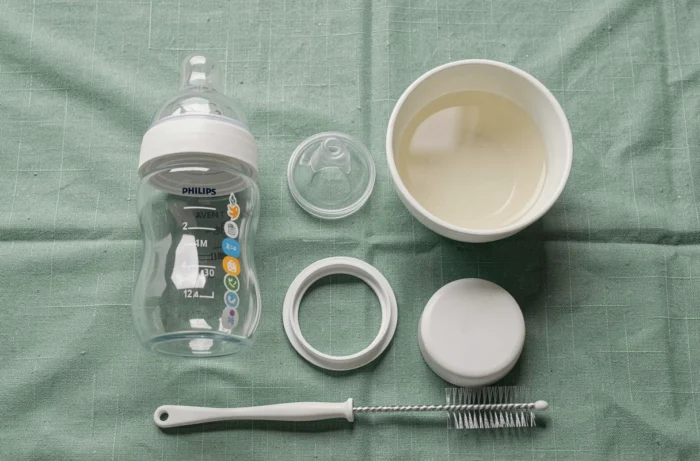
The Avent Natural Response bottle disassembles in the traditional way from the top. Cleaning is simple but requires a separate sterilizer or a pot of boiling water. The wide opening facilitates the passage of the bottle brush.
- Mam: screwable base, integrated self-sterilization, fewer parts to handle
- Avent: wide opening from the top, compatible with most sterilizers on the market
- Both brands are dishwasher safe (top rack), but Mam’s graduations may fade faster according to user feedback
The choice of bottle is based on the baby’s sucking profile, not the brand. An infant prone to gas colic with a lot of swallowed air will find more comfort with the Mam ventilation. A baby in mixed feeding who needs to maintain their active sucking reflex will adapt better to Avent’s Natural Response system. Testing both remains the most reliable method, as theory never perfectly predicts a newborn’s preference.