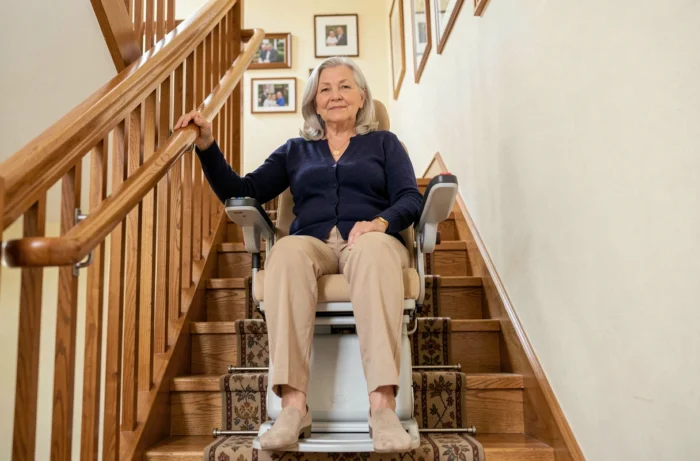
A narrow staircase with a tight turn at the first landing, a load-bearing wall encroaching on the stairwell, a user who can no longer bend their right knee: choosing a stairlift often comes down to these very practical constraints. The layout of the home is just as important as the user’s needs in determining which model to choose. Adapting the equipment to both is essential to making sure it is genuinely useful day to day.
Battery operation and power cuts: what to check before buying
People often assume that a battery-powered stairlift will continue to work normally during a power cut. In practice, performance varies depending on the model and the condition of the battery. Some devices allow a few emergency trips, while others can no longer power the seat swivel or retractable rail.
Before signing, ask the seller to confirm in writing what remains operational during a power cut: movement along the rail, seat rotation, and locking in the raised position. Also check the manual for the recommended charging conditions. A poorly maintained battery, or one used beyond its expected cycle life, will quickly lose capacity.
Browsing Maxi Senior stairlift equipment lets you review the technical specifications of each model and compare battery performance before contacting an installer.
Straight or curved rail: impact on cost and installation time
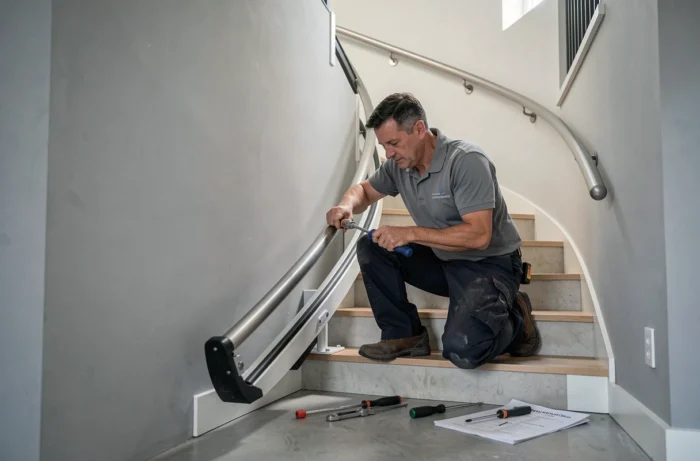
The rail is the key component of the installation. For a staircase with no turns or intermediate landings, a standard straight rail is sufficient. It can be installed in just a few hours and is the most affordable option on the market.
As soon as a staircase has a quarter-turn, a half-turn or an intermediate landing, a custom-made curved rail is needed. A technician takes precise measurements (angles, ceiling height and clearance width) to produce a rail that follows every turn. This bespoke design extends the delivery time and significantly increases the budget compared with a straight rail.
Here are a few points to clarify with the installer:
- Will the rail be fixed to the wall, the steps or both? Fixing it to the steps preserves the wall but reduces the clearance width.
- Can the rail retract or fold away at the bottom of the stairs so it does not obstruct other occupants?
- For an outdoor staircase (front steps, garden access), are the rail and seat weather-resistant? Ask for details of the anti-corrosion treatment.
Seat, perch or platform: choosing the right option for the user’s mobility
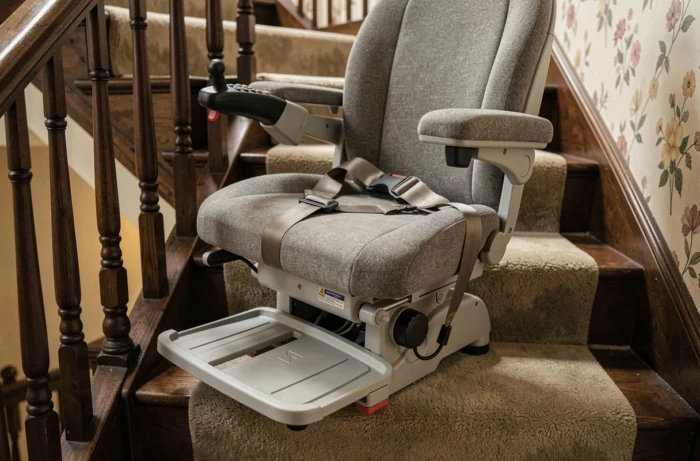
The type of seat depends directly on the physical abilities of the person who will use the device. A standard seat is suitable when the user can sit down and stand up independently, possibly with the help of folding armrests and a swivel seat.
When bending the knees becomes painful or impossible (after a recent joint replacement or with severe osteoarthritis), a standing stairlift, also known as a perch stairlift, allows the user to travel in a semi-standing position, supported by a small seat. This model takes up less space, making it suitable for narrow staircases.
For wheelchair users, an inclined platform lift is the solution. It attaches to the rail and carries the wheelchair directly. It takes up more space, so the staircase must be wide enough, and clearance work on the landing may sometimes be necessary.
NF EN 81-40 standard and maintenance contract: two safeguards to insist on
The NF EN 81-40 standard applies to stairlifts and inclined platform lifts for people with reduced mobility. It covers design, manufacture and installation. Ask the seller to confirm in writing that both the device and its installation comply with this standard, directly in the quote. A verbal assurance is not enough.
Maintenance is another point that is often overlooked. A stairlift that breaks down can make the upper floor inaccessible, creating a serious safety issue. Before buying, compare the maintenance contracts offered based on several criteria:
- Frequency of preventive maintenance visits (varies by manufacturer and intensity of use)
- Guaranteed response time in the event of a breakdown, including at weekends
- Whether technician call-out fees and wear parts are included in the contract
- Warranty exclusions (misuse, failure to charge the battery, modifications to the rail by a third party)
A well-tailored maintenance contract costs a fraction of the price of the device, but helps prevent lengthy downtime and unexpected repair bills.
Financial assistance for stairlift installation
Several schemes can reduce the amount you have to pay. MaPrimeAdapt’ helps fund home adaptation work for people experiencing a loss of independence. Eligibility depends on income and level of dependency.
Some pension funds, health insurance providers and departmental councils also offer additional assistance. A tax credit for home adaptations may also be available, depending on the household’s tax situation. The most reliable approach is to contact a France Rénov’ adviser before signing a quote: they can provide information on which grants can be combined and the applicable limits.
The amount of assistance and eligibility vary depending on whether you install a seat on a straight rail, a custom curved model or a platform. Every quote should specify the type of equipment selected, compliance with applicable standards and maintenance costs, so the application is complete when submitted.
Choosing a stairlift that suits your home is less about comparing catalogues than taking precise on-site measurements, discussing the battery, rail and seat with the installer, and obtaining written confirmation of compliance with applicable standards. This groundwork is what makes the difference between equipment used every day and a device abandoned after a few weeks.