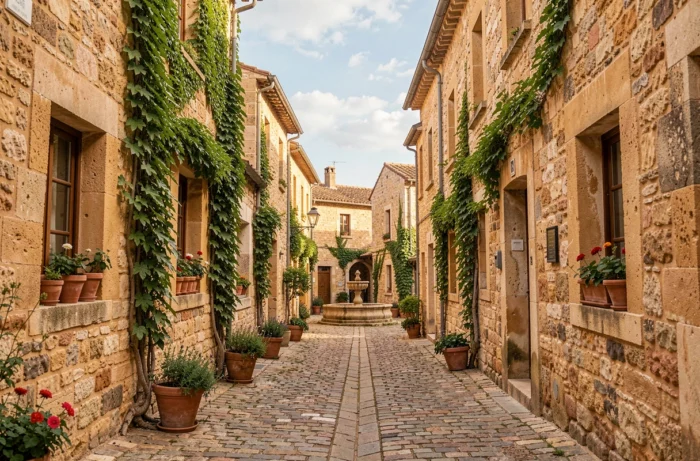
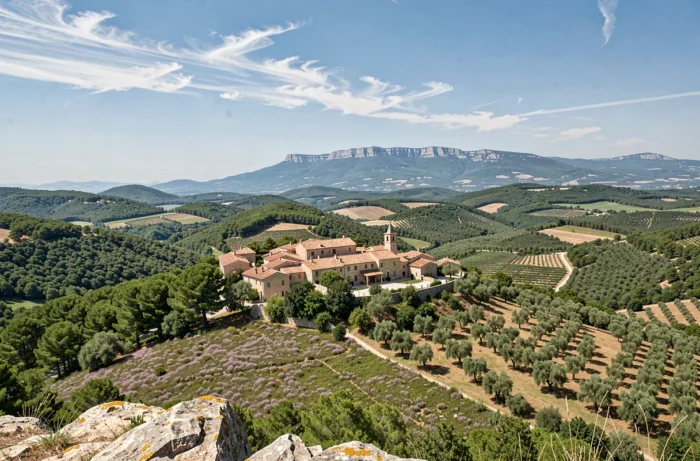
Bargemon sits on a promontory in the Haut-Var, at the foot of the Canjuers plateau, about fifteen kilometres north of Draguignan. The village retains much of its medieval walls, its stone-paved lanes and a church built in the 15th century. Listed among the municipalities supported by the Villages d’avenir programme, Bargemon now faces a twofold challenge: preserving its historic built heritage while giving it a contemporary purpose, particularly through its recently restored olive oil mill.
Bargemon’s olive oil mill: a restoration project still unfinished
The village’s last historic olive oil mill dates back to the 18th century. It still has its original stone millstone. Since 2021, the Moli d’Oli association has been leading a project to bring it back into operation, which has required extensive work.
The mill is operating again, but interior work is still underway. The restoration is therefore not yet complete. This sets Bargemon apart from many Provençal villages that simply preserve their mills as static displays, without putting them to practical use.
The ambition goes beyond simply safeguarding the site’s heritage. The mill hosts tours and workshops exploring the history of olive oil and its place in Mediterranean culture. The challenge for the municipality is to turn a restored monument into a living place of learning, capable of attracting visitors beyond the summer season. The municipality’s official website provides further information about this local heritage: https://www.bargemon.fr/.
One question remains unanswered: the interior work needed to complete the mill’s restoration is not detailed in the publicly available sources. Neither the timeline nor the remaining budget has been specified, making it difficult to estimate when the site will be operating at full capacity.
Medieval heritage and fountains: what visitors will actually find in Bargemon
Tourist guides call Bargemon “the pearl of the Haut-Var”. The village’s houses cluster around the Church of Saint-Étienne, an example of Provençal Romanesque architecture, and narrow lanes lined with stone façades. Parts of the 16th-century ramparts are still standing.
The fountains dotted throughout the village are a recurring visual landmark. Bargemon is known for the pure water that feeds them, a feature shared with other Haut-Var municipalities but one that takes on an almost theatrical quality here: every little square seems to be arranged around a water source.
The Honoré Camos Museum rounds out the visit, with collections relating to local history. For a village of this size, having a municipal museum is noteworthy, although opening hours and visitor numbers are not documented in the available sources.
What sets Bargemon apart from neighbouring Var villages
Several municipalities in the Haut-Var share a similar profile: a rocky promontory, medieval heritage and olive groves. Bargemon stands out for its combination of three features: an olive oil mill back in operation, a network of fountains that shapes the visitor route, and medieval walls that remain clearly visible in the urban fabric.
- The 18th-century mill is the only one in the village to have regained a productive and educational role, thanks to the work of the Moli d’Oli association.
- The fountains are more than decorative: they bear witness to an old water supply system that few neighbouring municipalities have preserved so visibly.
- The 16th-century ramparts form a clearly identifiable perimeter, whereas other villages retain only isolated fragments.
The Villages d’avenir programme and prospects for Bargemon
Bargemon is among the municipalities supported by the Villages d’avenir programme, a national initiative designed to help small rural communities with their development projects. Its inclusion signals recent institutional support, but the sources consulted do not specify which local project will benefit in practice.
Several possibilities seem plausible: completing the mill’s restoration, promoting visitor routes, or improving tourist facilities. Without official details, it would be unwise to claim that the programme is directly funding any particular project.
A village balancing preservation and visitor numbers
The Haut-Var does not have the profile of the French Riviera or the Luberon. Bargemon attracts visitors looking for a less crowded Provence, with an unspoilt setting and a slower pace of life. This low profile is both an asset and a vulnerability: it protects the village from overtourism, but also limits the economic benefits that could fund heritage maintenance.
The restored mill could become a focal point, provided the remaining work is completed and the workshops attract visitors outside the peak season. Villages that manage this transition successfully are those that bring together built heritage, active agriculture and cultural interpretation—three elements that Bargemon already has in embryonic form.
The landscape around the village—with its olive groves, the Canjuers plateau and the nearby Verdon Gorge—offers more than just a visit to the village centre. However, the village has yet to develop a discovery trail linking its urban heritage with the natural surroundings, a project that could give the Villages d’avenir support a clear purpose.