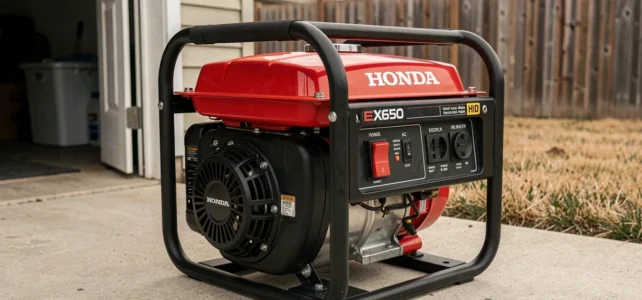
The Honda EX650 is a portable single-phase generator with a four-stroke engine, originally designed to provide lightweight backup power. Its rated power remains modest, suitable for construction site lighting, camping, or powering small electronic devices. Produced by Honda during a time when compactness and quiet operation were already selling points, the EX650 continues to circulate in the second-hand market.
Ignition Reliability and Electrical Diagnosis on a Used EX650
The first instinct when facing a Honda EX650 for sale is to check the condition of the ignition circuit. On this type of older engine, the ignition coil and capacitor are the components that age the worst. A faulty capacitor causes intermittent ignition failures, sometimes difficult to reproduce during a quick test.
Technical community threads report a recurring issue of total loss of electrical power at the output, while the engine runs normally. This symptom points to a defect in the internal alternator or its regulator, not the engine itself. Distinguishing between the two failures requires a multimeter and a minimum of method.
To learn everything about the Honda EX650, the characteristics of the electrical circuit are the logical starting point before any purchase. On a generator of this generation, the electrical condition matters more than the mechanical condition: a Honda overhead valve engine can tolerate years of storage, but a corroded stator is not easily repaired.
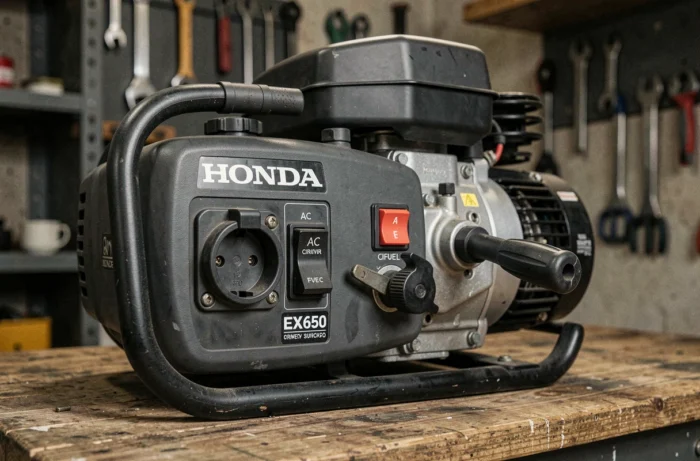
Honda EX650 Spare Parts: Actual Availability and Limits
Distributors specializing in original Honda parts maintain very detailed compatibility sheets for the EX650, covering ignition, filtration, and engine gaskets. This precision suggests that the model remains sufficiently in demand to justify active listing in catalogs.
What is Still Easily Available
- Air filters and spark plugs, shared with other small Honda engines of the same era, can be ordered from most garden and agricultural parts dealers
- Crankcase gaskets and piston rings remain available as original parts, as Honda has standardized these components across several ranges of portable engines
- The fuel tank, fuel tap, and carburetor can sometimes be found second-hand on international resale platforms, particularly in Asia
What is Problematic
Components specific to the generator part (stator, rotor, voltage regulator) are much rarer. Unlike engine parts, these electrical elements do not have reliable generic equivalents. Finding a stator in good condition often requires purchasing a second EX650 with a faulty engine to salvage the alternator part.
This observation creates a paradoxical situation: the thermal engine can still run for a long time, but the main function of the generator (producing electricity) depends on components whose supply remains uncertain.
Honda EX650 in Daily Use: Performance and Noise
The four-stroke engine of the EX650 stands out for its low noise level compared to generators of equivalent power. Several users describe it as one of the quietest vintage generators in its category. This discretion comes from both the full enclosure and the relatively low engine speed.
The power delivered remains limited. The EX650 easily powers lighting, a laptop charger, or a small television. Plugging in a high-consumption device (radiator, drill, vacuum cleaner) exceeds its capabilities and risks damaging the regulator.
Fuel consumption is very moderate, making it a generator suitable for prolonged low-load use. The compact tank limits autonomy in hours, but the consumption/power ratio remains a strong point of the Honda engine.
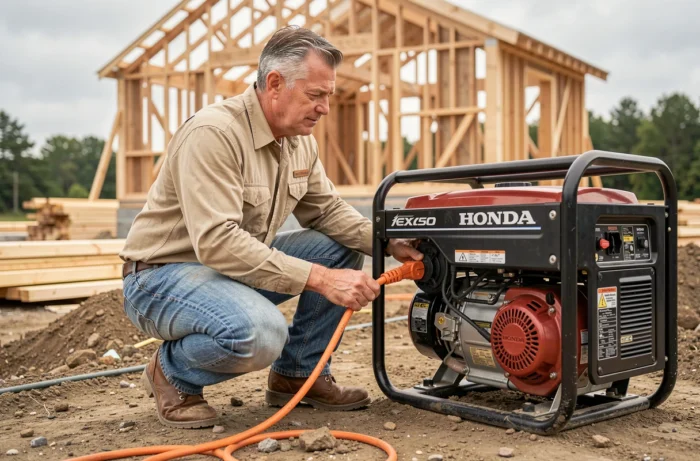
Buying a Honda EX650 Today: Useful Generator or Collector’s Item
The question of the relevance of a second-hand purchase deserves to be asked frankly. The market offers modern inverter generators that are lighter, equipped with electronic protections, and covered by a manufacturer’s warranty. Against this offer, the EX650 competes neither in power nor in features.
Its interest lies in three concrete elements:
- The Honda build quality of that era, with metal materials where recent entry-level models use plastic
- The low noise level, which remains competitive against much more expensive current models
- The pleasure of owning and maintaining a simple mechanical small engine, without electronic boards or digital sensors
However, the uncertainty regarding the condition of the internal electrical circuit represents the main risk. An EX650 with a faulty alternator becomes a thermal engine without electrical utility, unless time and money are invested in a now-rare part.
For strictly utilitarian use (backup power, construction site, regular camping), a recent Honda inverter generator remains a more rational choice. The EX650 is more aimed at enthusiasts of vintage mechanics, ready to diagnose and maintain a device whose technical simplicity is both its strength and its limitation.
The Honda EX650 holds a special place in the history of portable generators. Its reputation for engine reliability is justified, but it does not guarantee that the generator part will still function properly after decades of storage. Checking the ignition, testing the output with a multimeter, and accepting the possibility of needing to source specific parts: three steps to take before finalizing a purchase.