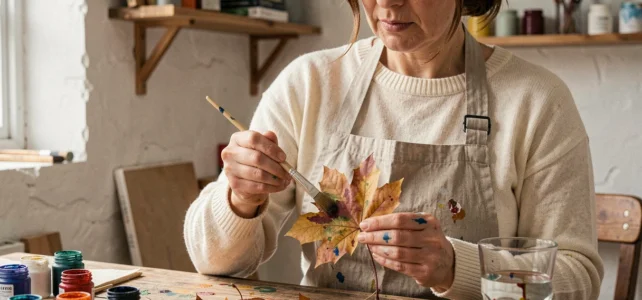
Painting on dried leaves is based on a technical paradox: the support is fragile, porous, irregular, and yet capable of accommodating effects that paper does not allow. The veins, texture, and partial transparency of the leaf create visual effects unique to each leaf. Everything is determined upstream, well before the first brushstroke, in the choice of drying method and preparation of the support.
Drying leaves for painting: press, silica gel, or microwave
The drying method directly determines what the leaf can receive in terms of paint. A leaf pressed in a book for a week remains flexible, relatively flat, and retains enough intact fibers to absorb a wash. In contrast, a leaf air-dried for more than three months becomes brittle at the slightest touch.
The methods borrowed from floral art in resin change the game. Silica gel drying preserves the three-dimensional relief of the veins and maintains a significantly brighter color than traditional pressing. Microwave-assisted drying produces a comparable result in just a few minutes, with a risk of overheating that weakens the thinnest edges.
Freeze-drying, used in botanical conservation, offers the best preservation of cellular structure. The leaves obtained retain a volume close to their fresh state. This technique remains less accessible to individuals, but botanical art workshops are beginning to offer freeze-dried leaves ready for painting.
The choice of drying influences the type of creation: a pressed leaf is suitable for flat painting (mandalas, geometric patterns), while a leaf dried with silica gel allows for three-dimensional work, with selective gilding on the reliefs or a watercolored wash that follows the hollows of the veins.
Several artists exploring painting techniques on dried leaves recommend systematically testing a sample before embarking on a chosen leaf, as two leaves of the same species can react differently depending on their residual hydration level.
Pre-treatment with glycerin: a step that changes the support
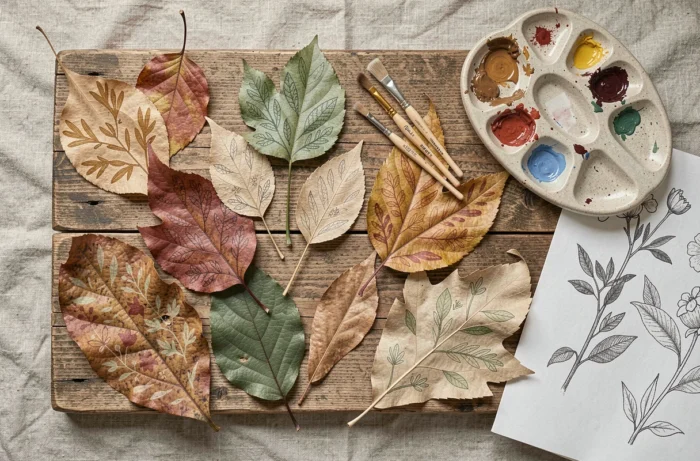
Soaking the leaves in a mixture of water and vegetable glycerin (classic ratio: one part glycerin to two parts hot water) profoundly alters their behavior. Glycerin gradually replaces cellular water and makes the tissue flexible, almost textile. The result is a leaf that no longer breaks, that bends without cracking, and that accepts acrylic paint without repelling it from the surface.
This treatment opens up uses that usual tutorials do not address. A glycerinated leaf can be sewn, integrated into a handmade binding, glued onto a lampshade, or assembled into a hinged panel. The surface becomes stable enough to receive multiple layers of color without deforming.
- Oak and beech absorb glycerin well due to their dense vascular network and retain a warm hue after treatment.
- Maple offers a wide and even surface, ideal for detailed compositions with a fine brush.
- Magnolia, with its thick and leathery leaves, supports mixed techniques (acrylic and marker) without tearing.
- Laurus, compact and resilient, is suitable for small formats and intricate patterns.
The soaking time varies from a few days to a week depending on the thickness of the leaf. An excess of glycerin leaves a greasy film on the surface that prevents paint adhesion. The leaf should be blotted with absorbent paper before starting to paint.
Acrylic, watercolor, or Posca: which paint on dried leaves
Watercolor works on untreated pressed leaves, provided you work with a light wash. The pigments settle in the micro-grooves of the leaf and create a transparency effect that is impossible to achieve on paper. However, too much water weakens the leaf and causes tears along the veins. An almost dry brush yields the best results.
Acrylic, which is more opaque, is suitable for glycerinated or waxed leaves. It adheres well, dries quickly, and allows for layering. The colors remain vibrant for a long time if the leaf is then varnished. Acrylic markers like Posca provide a practical alternative for fine patterns (dots, lines, lettering) without having to manage dilution.
Beeswax applied after painting prolongs preservation for several months. It protects both the pigment and the plant support from ambient humidity. The process involves quickly dipping the painted and dry leaf into melted wax, then allowing it to cool on parchment paper.
Varnish as a final fixative
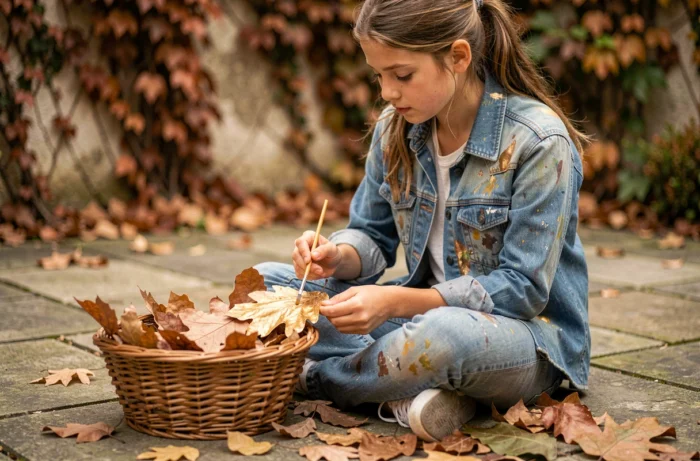
A matte spray varnish, applied from a distance to avoid drips, stabilizes the pigments without altering the appearance of the leaf. Glossy varnish gives a more lacquered finish that enhances saturated colors but masks the natural texture of the leaf. The choice depends on the desired effect.
Painted leaves: long-term preservation and framing
An unprotected painted leaf degrades within a few weeks. Humidity, direct light, and handling accelerate browning and crumbling. Framing under glass with a spacer mat remains the most reliable method for preserving a painted leaf for several years.
The spacer mat prevents contact between the glass and the painted surface, avoiding condensation and pigment transfer. A deep frame (box type) works even better for leaves dried with silica gel that retain volume.
- Avoid direct sunlight exposure, which fades pigments and dries out the support within weeks.
- Store unframed leaves between two sheets of tissue paper, in a dry place, away from light.
- Never laminate a painted leaf: the heat from the laminator alters the paint and flattens the reliefs.
A well-prepared and properly framed leaf can remain intact for several years, even with bright colors. Field reports vary on the exact durability depending on the species and paints used, but there is a consensus on the importance of the trio of appropriate drying, fixative, and protection against humidity.
Painting on dried leaves requires less equipment than one might think, but more patience in preparing the support than in the act of painting itself. A glycerinated oak leaf, painted with acrylic and waxed, remains one of the most durable combinations for a result that is both natural and colorful.