
The professional extranet of the CIVC (Champagne Committee) centralizes harvest declarations, parcel tracking, and regulatory documents of the Champagne sector. Access to this space relies on a unique username/password pair for each profile, with rights managed by an administrator account within each organization. Understanding this authentication mechanism avoids most of the blockages encountered during login.
Role of the administrator account in accessing the CIVC extranet
Each company registered with the Champagne Committee has a unique administrator account. This profile manages the creation, modification, and deletion of access for all employees. A username can work on the CIVC extranet without necessarily granting access to all related services, such as the eCO platform (certificates of origin).
The right to access a given service depends on a permission granted by this administrator. Before looking for a technical problem, the first check is to confirm that the profile being used has the necessary permissions. A seasonal employee, for example, may have a valid username but be denied entry to certain modules due to lack of specific permission.
To successfully log in to the CIVC extranet my account on the first attempt, checking rights with the administrator of the organization remains the most effective reflex, well before contacting technical support.
CIVC account blockage: understanding automatic locking

The portal applies an automatic locking after several failed attempts. This security mechanism does not distinguish between a typo and a malicious attempt. Three or four incorrect entries are sometimes enough to suspend access for a variable duration, without explicit notification.
The unlocking delay does not follow a visible rule for the user. Some accounts become accessible again after a few minutes, while others remain locked for several hours. Trying to reconnect immediately after a blockage often prolongs the suspension.
What triggers the lock in practice
- Entering a password from multiple devices simultaneously (desktop computer and phone, for example) multiplies the failures counted by the server.
- Pasting a temporary code received by email with an invisible space at the end, common when copying from certain messaging apps, generates a silent rejection.
- Using a password saved by the browser when it has been changed on the portal side causes repeated failures without the user realizing it.
The most reliable solution after a blockage is to wait, then reset the password through the official procedure rather than multiplying attempts.
Browser cache and CIVC extranet: a direct link to display errors
The CIVC technical support regularly recommends clearing the cache. This advice, often perceived as generic, targets a real problem. The browser locally stores elements of the login page, including expired session tokens or outdated scripts after a portal update.
When the portal evolves (interface modification, security patch), the browser may continue to load an outdated version of the authentication page. The form displays, the validation button responds, but the request sent to the server no longer matches the expected format. The result: access denial without an explicit error message.
Targeted procedure rather than complete cleaning
Clearing the entire cache also removes active sessions on other sites. A more precise approach is to delete only the data from the domain comitechampagne.fr in the browser settings. On Chrome, the “Cookies and site data” section allows filtering by domain. On Firefox, the equivalent option is found under “Privacy and Security”.
After this operation, restarting the browser before attempting a new login avoids reloading elements from RAM.
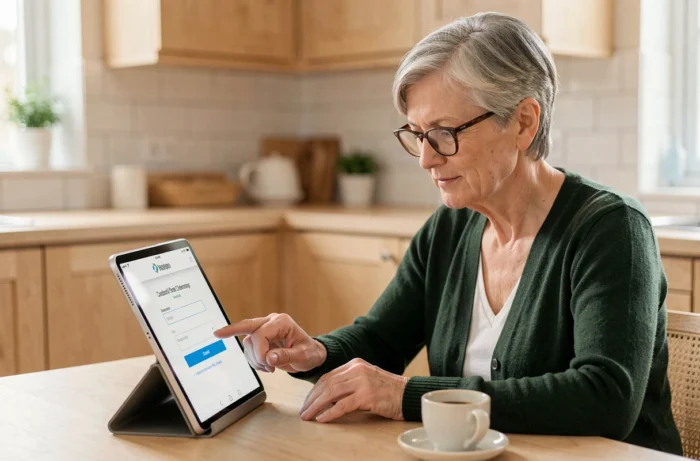
Choosing the second factor of authentication for a CIVC account
The recommendations from ANSSI published since 2023 clearly distinguish between multi-factor authentication and strong authentication. SMS, long used as the default second factor, is now considered a vulnerable method for sensitive professional access.
For an extranet account that provides access to parcel data, declared volumes, and contractual documents, a TOTP application (like Google Authenticator or FreeOTP) offers a higher level of protection than the code received via SMS. The locally generated code does not transit through the telephone network and is not interceptable by line hijacking techniques (SIM swapping).
Physical FIDO2 keys, still rare in the wine sector, represent the most robust option. Their cost remains moderate, and their use is limited to plugging in the key during login.
Disabling unused accounts on the CIVC portal
The turnover of seasonal staff in Champagne creates a specific risk: active usernames linked to individuals who no longer work in the organization. Each non-disabled account represents a potential entry point to the operation’s data.
The company account administrator can revoke access directly from the extranet. Disabling a profile at the end of a seasonal employee’s mission limits exposure without requiring intervention from CIVC support. This operation does not erase the history of actions performed under this profile, which remains consultable for traceability purposes.
Since the law of January 24, 2023, filing a complaint within 72 hours of discovering an account compromise conditions the insurer’s coverage of losses related to the incident. Keeping orphaned active accounts complicates the detection of unauthorized access and extends the response time.
A quarterly audit of the list of authorized profiles, cross-referenced with actual staff, is sufficient to maintain a coherent access perimeter on the Champagne Committee portal.