Arranging a child’s room involves making choices between decorative approaches that yield very different results in terms of longevity, safety, and budget. Neutral palette or bright colors, adaptable furniture or fixed pieces, natural or synthetic materials: each combination creates a space whose aesthetic and functional lifespan varies significantly. This article compares the main options to identify those that deliver on their promises over the years.
Neutral palettes vs. bright colors in a child’s room: what each option entails
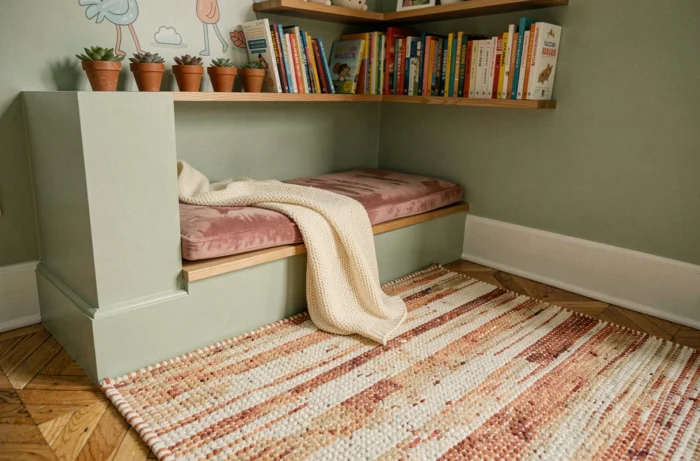
Since 2025, the dominant trend in children’s room decoration leans towards neutral and natural palettes: sandy beige, soft terracotta, sage green, off-white. This trend, often described as warm minimalism, favors few objects but many textures (linen, rattan, light wood, plant fibers).
This approach has a measurable advantage: a neutral palette remains cohesive as the child grows and changes interests, delaying the need for a complete room overhaul. In contrast, a room saturated with thematic colors (characters, bold patterns) generally requires a complete redo after a few years.
| Criterion | Neutral palette / warm minimalism | Colorful / thematic palette |
|---|---|---|
| Aesthetic lifespan | Long (adaptable until adolescence) | Short (often outdated in 2-3 years) |
| Renewal cost | Low (accessories to change) | High (paint, furniture, textiles) |
| Visual stimulation | Moderate, calming | Strong, playful |
| Child’s personalization | Easy through addition (stickers, posters) | Limited (fixed universe) |
| Resale of furniture | Easier (universal tones) | More difficult (specific tastes) |
An effective compromise is to paint the walls in a neutral tone and focus color on removable elements: cushions, curtains, rugs. This way, the child can express their desires without the need to rethink the room’s structure. Resources like lamaisonnettedebarbichounette.fr help find accessories suited to this modular logic.
Child furniture safety: what the European regulation 2023/988 changes
The choice of furniture in a child’s room is not solely aesthetic. The EU Regulation 2023/988 on general product safety, applicable since December 13, 2024, modifies the obligations of manufacturers and distributors of children’s furniture.
This regulation imposes a general safety obligation covering risk analysis, traceability, and clear information, even in the absence of specific CE marking for household furniture. Brands must now demonstrate that their products remain safe under real usage conditions: a child climbing on a dresser, pulling a drawer, or hanging from a shelf.
Concrete points of vigilance for bedroom furniture
- Tall furniture (wardrobes, bookshelves, dressers) must be secured to the wall with an anti-tip device. This remains the primary factor for serious accidents in children’s rooms, and wall anchoring is the most effective preventive measure.
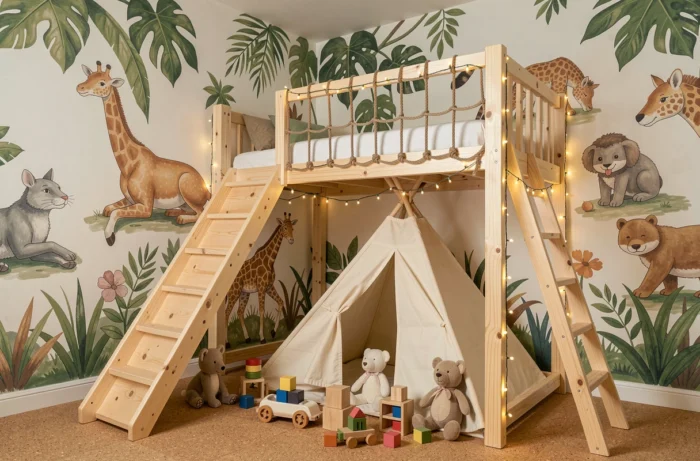
- Children’s beds (cribs, cabin beds, bunk beds) must meet specific standards that govern the height of barriers, spacing of slats, and structural resistance. Checking for compliance before purchase avoids unpleasant surprises.
- The paints and finishes of the furniture must be free from harmful substances. Manufacturers compliant with regulation 2023/988 provide accessible technical documentation on this point.
This regulatory constraint has a direct consequence on playful decoration: a designer piece is worthless if it is not properly secured. Aesthetics come second to structural stability, regardless of the chosen style.
Cabin bed, convertible bed, or bunk bed: which choice for which use
The bed is the centerpiece of the child’s room, both in terms of space occupied and budget. Three formats dominate the market, each with very distinct usage logics.
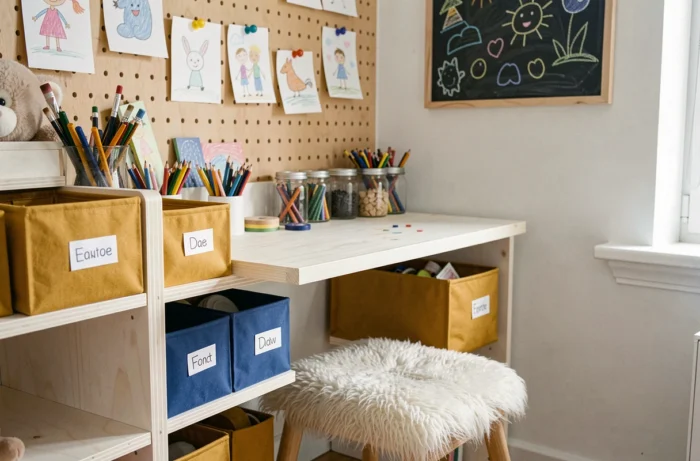
The cabin bed appeals with its playful design and ability to make bedtime an enjoyable moment. Placed on the floor or slightly elevated, it is suitable for children as soon as they transition from a crib. Its main limitation: it occupies significant visual space and integrates poorly into a small room.
The convertible bed, on the other hand, adapts to the child’s growth through an extension or transformation system. It is the most financially rational option for families who do not wish to purchase a new bed every three years. The design remains understated, which naturally aligns with a neutral palette.
The bunk bed addresses a specific constraint: accommodating two children in the same room. It frees up floor space for play or storage. Safety standards recommend reserving the top bunk for children over six years old, a non-negotiable point.
Textures and natural materials: creating a warm atmosphere without overloading
The warmth of a child’s room relies more on materials than on the multiplication of objects. Light wood (beech, birch, raw pine) provides a bright base. Rattan and plant fibers add depth without visually weighing down the room.
Linen for curtains and bedding, combined with a washable cotton rug, creates a layering of textures that makes the space inviting even with very little furniture. This approach corresponds to the warm minimalism mentioned earlier: each element has a function, nothing is purely decorative.
For personalization, interchangeable frames on the wall allow displaying the child’s drawings or age-appropriate illustrations. This system is inexpensive, easily renewed, and avoids repeatedly drilling holes in the walls for heavy decorative shelves.
The most durable child’s room is one that rests on neutral and solid foundations, complemented by easily replaceable accessories. It is better to invest in safe and understated furniture than in spectacular decoration that needs to be redone every two years. The European regulation 2023/988 also reminds us that structural safety takes precedence over appearance, a criterion that should guide every purchasing decision.