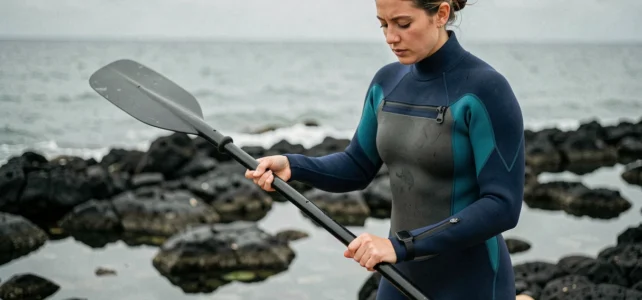
Choosing water sports equipment comes down to balancing three variables: the applicable safety standard, the type of practice, and the navigation conditions. Since the decree of October 11, 2024, Division 240 has been strengthened, rendering some of the old equipment recommendations obsolete. This article measures the concrete differences between categories of equipment to help make an informed choice.
Standard NF EN ISO 12402: comparison of buoyancy levels by use
The classification of life jackets is based on the NF EN ISO 12402 standard, which defines buoyancy thresholds expressed in newtons. The choice of the right level directly depends on the navigation area and the user’s profile.
| Buoyancy Level | Main Use | Typical Context |
|---|---|---|
| 50 N (buoyancy aid) | Calm waters, immediate proximity to shore | Paddle, kayaking in sheltered water |
| 100 N (coastal life jacket) | Coastal navigation, semi-sheltered waters | Light sailing, water skiing, towed buoy |
| 150 N (offshore life jacket) | Offshore navigation, difficult conditions | Offshore cruising, outings in open sea |
A regulatory point often overlooked: children weighing 30 kg or less must wear a minimum 100 N life jacket, regardless of the navigation area. This requirement from the consolidated Division 240 applies equally to a towed buoy outing or a sailing trip.
Finding all the equipment on the H2O Sport website allows for direct filtering by buoyancy level, simplifying compliance with these thresholds.
Mandatory kill switch and towed gliding: what Division 240 changes
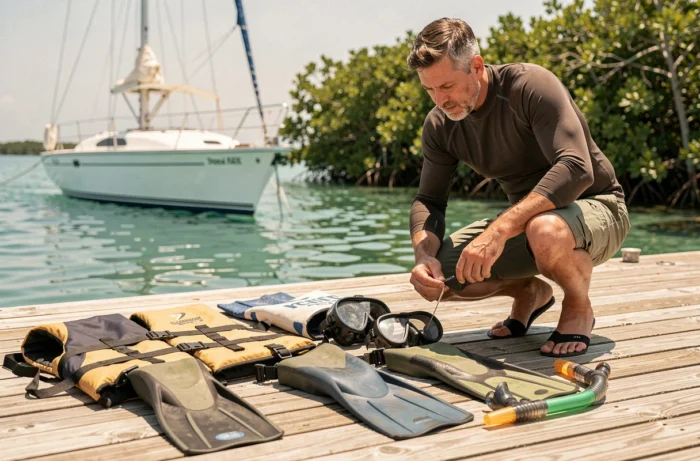
The decree of October 11, 2024, introduced a requirement that directly concerns practitioners of towed sports (wake, buoy, water skiing): the boat’s kill switch must be worn and connected by the driver throughout the activity. This rule aims to immediately cut the engine in case of the driver’s fall, thus protecting the towed person.
In practical terms, this means that the kill switch is now part of the safety equipment just like the life jacket. A boat without a functional kill switch or whose driver is not wearing it is subject to fines.
The consolidated version of Division 240, incorporating changes until May 21, 2026, is the only enforceable reference for the safety equipment of pleasure vessels under 24 meters. Checklists published before October 2024 are partially outdated.
Wetsuit: thickness and closure according to water temperature
The wetsuit remains the most technical piece of equipment to choose, as two parameters interact: the thickness of the neoprene and the closure system. One determines thermal insulation, while the other affects waterproofing and freedom of movement.
Neoprene thickness according to practice
The colder the water, the thicker the wetsuit should be. However, a wetsuit that is too thick for the actual temperature reduces mobility without thermal benefit.
- Temperate waters (above 20 °C): a shorty or thin wetsuit is sufficient for paddleboarding, summer surfing, or water skiing on a lake.
- Cool waters (between 15 and 20 °C): a full wetsuit of intermediate thickness covers the majority of uses in the Atlantic or English Channel from May to September.
- Cold waters (below 15 °C): a thick wetsuit with a hood and neoprene booties becomes necessary to limit thermal loss, especially in diving or winter surfing.
Closure systems
Wetsuits with back zippers remain the most common and easiest to put on. In contrast, models with front zippers (chest zip) or without zippers (zipless) offer better waterproofing at the neck and back, areas where water often enters.
The choice depends on the sport practiced. A surfer who spends time submerged will prefer a chest zip. A water skier, whose immersions are brief, can settle for a back zip without significant penalty.
Sun protection and often underestimated accessories
Protective accessories are not included in Division 240, but their absence comes at the cost of comfort and sometimes safety. Some items deserve as much attention as the life jacket or wetsuit.
- Polarized sunglasses reduce glare on the water, an underestimated factor of visual fatigue during long navigation or fishing sessions.
- An anti-UV lycra protects the torso during prolonged sessions in warm waters, where a wetsuit is not justified.
- The leash (safety cord) connects the practitioner to their board in surfing, stand-up paddle, or bodyboarding. Without a leash, a lost board can drift quickly and endanger other users.
- The waterproof bag keeps phone, keys, and identity papers safe, a simple reflex that avoids complications on land after the session.
These accessories represent a modest budget compared to a wetsuit or life jacket, but forgetting them significantly degrades the experience on the water.
The choice of water sports equipment boils down to a three-step verification: regulatory compliance (buoyancy level, kill switch), thermal adaptation (thickness and closure of the wetsuit), and then adding protective accessories. The consolidated Division 240 after May 2026 remains the reference document to ensure that nothing is missing on board before taking to the water.