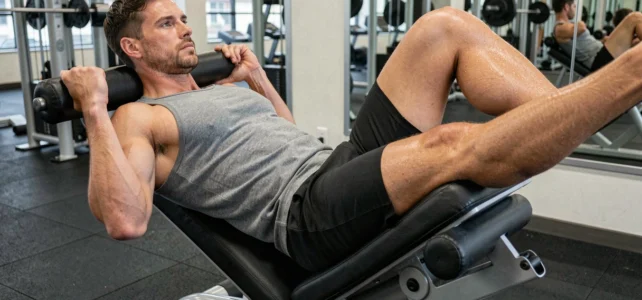
Which abdominal exercise actually activates the most muscle fibers on a Roman chair? Electromyography (EMG) measurements taken on thirteen abdominal movements provide a clear answer. The knee raise on the Roman chair (captain’s chair type) ranks first for oblique activation and second for the rectus abdominis among all the exercises tested.
This data allows for structuring a workout that targets the right muscles in the correct order, rather than repeating random sets.
Muscle Activation Comparison: Roman Chair vs. Floor Exercises
Most practitioners choose their abdominal exercises out of habit. The floor crunch remains the default movement. The EMG data tells a different story.
| Exercise | Rectus Abdominis Activation | Oblique Activation |
|---|---|---|
| Knee raise (captain’s chair) | Very high (2nd rank EMG) | Highest (1st rank EMG) |
| Floor crunch | Moderate | Low |
| Suspended straight leg raise | High | High |
| Ball crunch | Moderate to high | Moderate |
The floor crunch loses tension halfway through the range. In contrast, suspended movements on the Roman chair maintain a progressive resistance throughout the entire movement, which explains the higher EMG scores.
This table shows that building a Roman chair abs program around the knee raise and its variations is not an arbitrary choice, but a decision supported by physiological measurements.
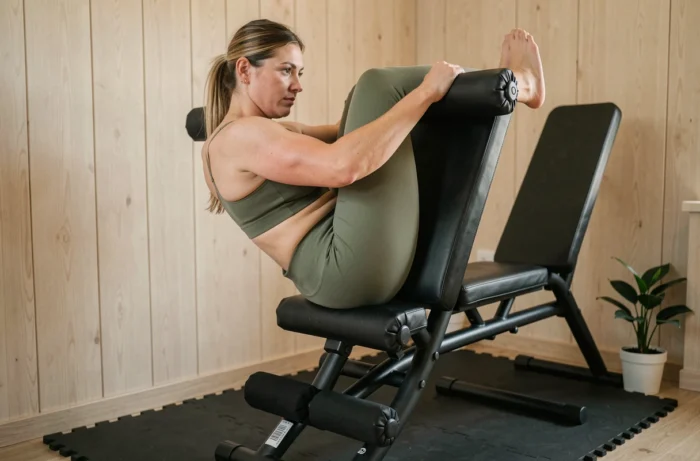
Obliques and the Roman Chair: Why This Targeting Changes the Game
Content about abs on the Roman chair often mentions the obliques in passing, as a bonus. The EMG data says otherwise: the obliques are the primary muscle group engaged during the knee raise on the captain’s chair.
The obliques play a central role in trunk rotation, lateral stabilization, and force transfer between the lower and upper body. A deficit in strength in these muscles results in lumbar compensations during compound movements like squats or deadlifts.
Variations That Emphasize Oblique Work
- Knee raise with pelvic rotation: bring the knees towards the opposite shoulder while controlling the descent over three seconds. This movement adds a rotational component that amplifies oblique recruitment.
- Suspended windshield wipers: legs extended horizontally, slowly swing from side to side. Gravitational resistance increases as the angle moves away from vertical.
- Unilateral knee raise: raise one knee at a time to create lateral imbalance. The opposite side works in anti-rotation stabilization.
These three variations exploit the mechanical specificity of the Roman chair. On the floor, reproducing such a level of tension on the obliques requires additional weights or bands.
Hip Flexors: The Factor the Program Must Integrate
During leg raises or knee raises, the hip flexors (psoas-iliacus, rectus femoris) work in conjunction with the abdominals. This is not a flaw; it is a biomechanical reality. The problem arises when the flexors take over because the abdominals fatigue.
Signs of flexor dominance are recognizable: the lower back arches, the knee raise accelerates uncontrollably, and pain appears in the groin fold. When these signals manifest, the set should stop.
Technique to Maintain Abdominal Tension
Before each repetition, perform a pelvic retroversion (tilt the pubis upwards). This pelvic lock pre-activates the transverse and rectus abdominis before the movement begins. Without this retroversion, the psoas dominates from the first degrees of hip flexion.
Reducing the range rather than forcing it is more productive for the abdominals. A knee raise stopped at hip height with a locked pelvis generates more abdominal tension than a full leg raise executed with momentum.
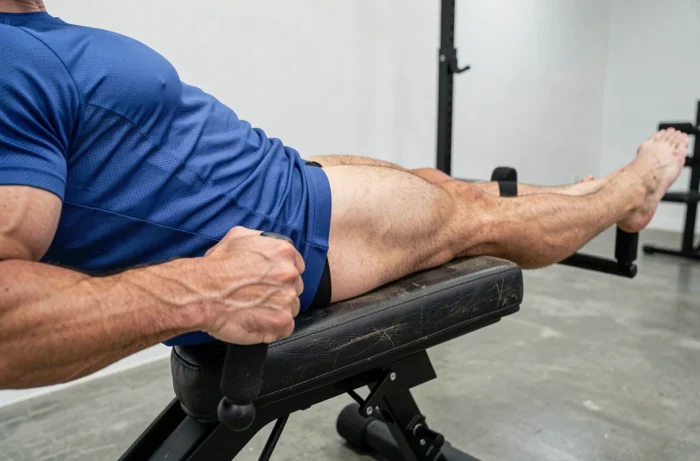
Structure of an Abs Workout on the Roman Chair Over Three Sessions
Training frequency matters more than the volume per session for the abdominal muscles. Three short weekly sessions produce better results than a single long session because the abdominals recover faster than larger muscle groups.
| Session | Main Exercise | Secondary Exercise | Sets x Repetitions |
|---|---|---|---|
| A | Classic knee raise | Isometric suspended plank | 4 x 10-12 / 3 x 20-30 s |
| B | Knee raise with rotation | Unilateral knee raise | 4 x 8-10 per side / 3 x 8 |
| C | Straight leg raise | Suspended windshield wipers | 4 x 8-10 / 3 x 6 per side |
Session A primarily targets the rectus abdominis. Session B emphasizes the obliques through rotation. Session C combines a high-intensity overall movement with an anti-rotation exercise. This alternation covers the entire abdominal musculature without repeating the same movement patterns.
Progression and Overload
On the Roman chair, overload does not come from adding weights (at first). It comes from slowing down the eccentric phase. Adding two seconds to the descent of the knee raise transforms a controlled exercise into a demanding movement. When the 3-1-2 tempo (descent, pause, ascent) becomes smooth over twelve repetitions, a light weight between the feet or knees becomes the next step.
EMG data confirms what practice shows: the Roman chair, used methodically, surpasses floor exercises for overall abdominal recruitment, particularly for the obliques. The limiting factor is neither the equipment nor the number of repetitions, but the quality of pelvic locking and tempo control in each set.