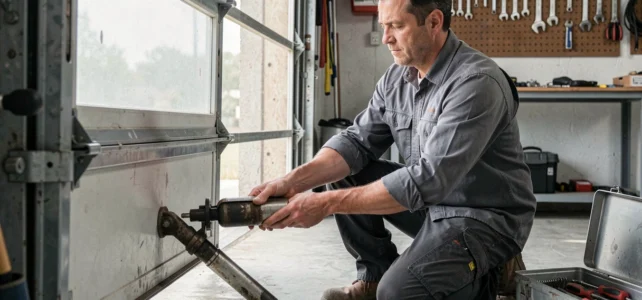
The garage door actuator is a mechanical component that compensates for the weight of the door panel during each opening and closing maneuver. When it loses its pushing capacity, the door becomes heavy, descends too quickly, or refuses to stay open. Replacing this part does not require advanced skills, but it does require following a precise order to avoid any risk.
Force in newtons and stroke length: choosing the right replacement actuator
Before touching any bolts, the choice of actuator determines the success of the operation. An unsuitable model will make the door more difficult to maneuver than before the intervention.
The force expressed in newtons corresponds to the push that the actuator exerts to lift the door panel. It directly depends on the weight of the door. An actuator that is too weak will not compensate for the mass, while an actuator that is too powerful will make manual closing difficult.
The total length and the stroke (distance between compressed position and deployed position) must match the dimensions of the old model exactly. A difference of a few centimeters is enough to prevent proper attachment or limit the opening range.
- Note the reference inscribed on the body of the old actuator (often engraved or printed on the tube label).
- Measure the compressed length and the deployed length with a tape measure, actuator disassembled if possible.
- Check the type of attachment at both ends: ball joint, clevis, threaded rod, or flat end. The spacing between the anchor points must remain identical.
- Check compatibility with the door brand (Novoferm, Tubauto, or others) as some models use proprietary tube diameters.
On a tilting door, it is recommended to replace the garage door actuator by replacing both actuators simultaneously, even if only one seems faulty. A difference in push between the left and right sides destabilizes the door panel and accelerates the wear of the new actuator.
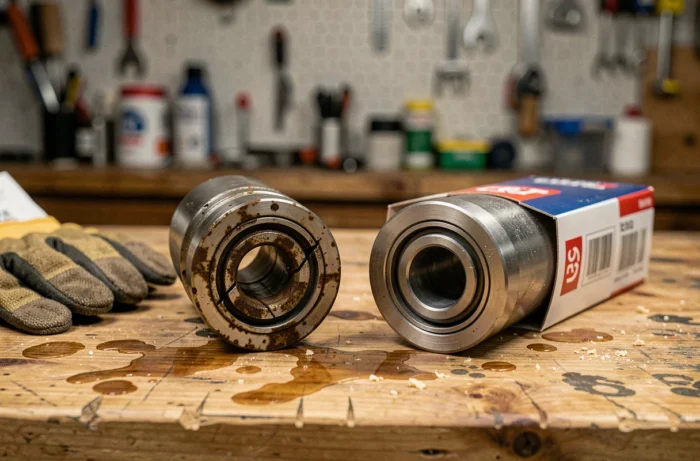
Gas actuator or spring actuator: what the technical choice changes during disassembly
The two technologies are handled differently. Confusing the two during disassembly can lead to an unpleasant surprise.
The gas actuator (the most common on residential garage doors) contains pressurized nitrogen in a sealed tube. It cannot be repaired or recharged. When it loses pressure, it must be completely replaced. Its handling remains simple: no stored mechanical tension is released abruptly during disassembly, unlike a torsion spring.
The spring actuator uses an internal helical spring to generate the pushing force. This type is less common on domestic garage doors but can be found on some older models. The spring may retain residual tension even when the door is closed, which requires securing the door panel before any intervention.
In both cases, the door must be kept in the closed position and mechanically secured (using clamps on the rail or a wedge under the panel) before removing the first attachment point of the actuator.
Disassembling and installing a tilting garage door actuator: order of operations
The most common mistake is to remove the upper attachment point first. On a tilting door, the actuator works in compression when the door is closed. Releasing the top of the actuator without securing the door panel can cause a sudden movement of the door.
Here is the order to follow:
- Close the door completely and block it with a wedge or clamp on the guide rail.
- Unscrew or unclip the lower attachment of the actuator (on the frame side), then the upper attachment (on the arm or moving panel side).
- Remove the old actuator and compare its dimensions with the new model before proceeding.
- Position the new actuator by engaging the upper attachment first, then the lower attachment.
- Tighten both anchor points without excessive force (too violent a tightening on a plastic ball joint can crack it).
- Remove the safety wedge and manually test the opening over the entire stroke, slowly.
If the door has a motorization, it must be disconnected from the door panel before the operation. The manual release cord (present on most chain or belt operators) allows switching to manual mode during the replacement.
Checks after installation
Once the two new actuators are in place, the door should remain stable at mid-stroke without being held. If it descends, the force of the actuators is insufficient. If it rises by itself, the push is excessive. The balance at mid-stroke is the reference test to validate the replacement.
The lateral play of the door panel in the rails also deserves a visual check. An actuator whose length differs slightly from the original can alter the alignment of the panel and cause asymmetric friction.
Maintenance log and regulatory obligations for garage doors
Replacement tutorials often overlook the regulatory aspect, which directly concerns the safety of the installation.
For automatic garage doors in residential buildings, the decree of November 12, 1990, requires two maintenance visits per year carried out by a competent person, as well as the keeping of a safety register. The replacement of an actuator falls within the scope of these interventions and must be recorded.
In individual homes, there is no legal obligation for periodic maintenance. Replacement remains at the owner’s initiative. Keeping the actuator’s invoice and noting the installation date in the door’s maintenance log (when it exists) facilitates tracking over time.
Since January 8, 2026, Regulation (EU) 2024/3110 on construction products strengthens documentation requirements for garage doors subject to standard EN 13241. A motorized door must be delivered with a Declaration of Performance, a CE Declaration of Conformity, and maintenance instructions. These documents serve as a reference for identifying compatible parts during a replacement.
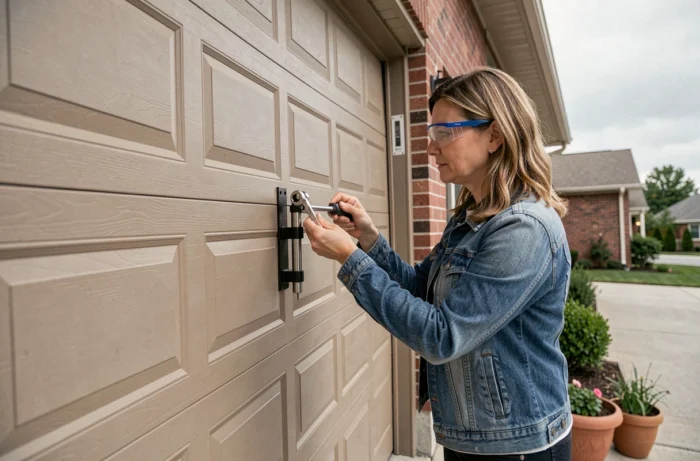
Changing a garage door actuator remains an accessible operation provided two points are respected: choosing a model with dimensions and force strictly identical to the original, and following the disassembly order that neutralizes the risk of uncontrolled movement of the door panel. A standard gas actuator costs much less than an emergency repair intervention on a stuck door.