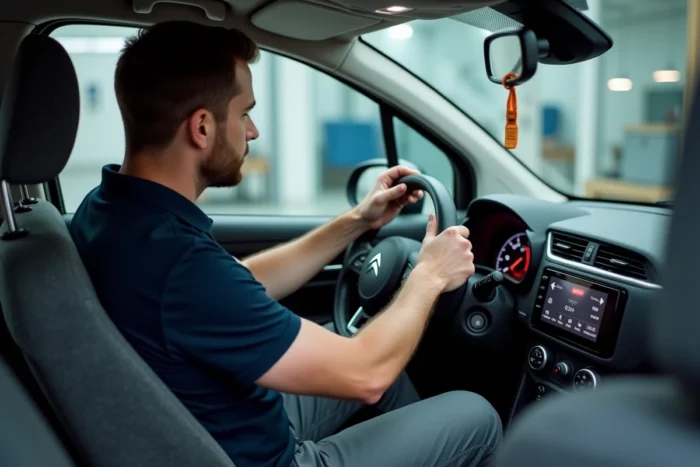
On Citroën C3 equipped with recent PSA platforms, the “energy saving mode” message displayed on the dashboard corresponds to a 12 V battery protection function. The system automatically cuts off certain accessories (radio, air conditioning, USB ports) to preserve the engine’s starting capacity. This mechanism is distinct from the voluntary ECO mode, which can be activated or deactivated via the dashboard, modifying the engine and transmission behavior to reduce fuel consumption.
12 V Battery Protection and ECO Mode: Two Distinct Logics on the Citroën C3
The confusion between these two systems is common. The ECO mode, often activated by default at startup, slightly limits the accelerator response and optimizes gear shifts to minimize consumption. It is generally deactivated via a physical button or an option in the central display menu.
The energy saving mode related to the 12 V battery works differently. It engages without driver intervention when the system detects a voltage that is too low. As long as the electrical issue is not resolved, this mode returns at each startup, regardless of the setting chosen for ECO mode. To remove the Citroën C3 energy saving mode permanently, it is therefore necessary to first identify which of the two systems is at fault.
If the message disappears after a few minutes of driving and then reappears at the next startup, the 12 V battery is likely at the end of its life or poorly charged. If the ECO light remains on continuously but all equipment functions normally, it is simply the economic driving mode that is activated.
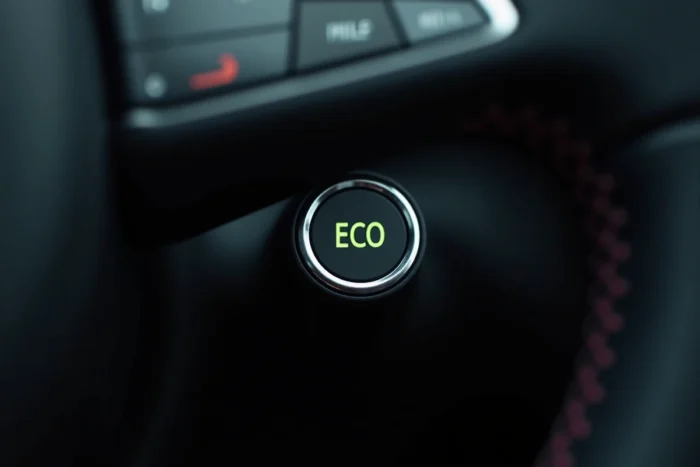
Deactivating ECO Driving Mode on the Citroën C3 Thermal
On third-generation C3s (C3 III), ECO mode is activated by default each time the vehicle is started. The procedure to turn it off varies depending on the year and equipment level.
- On versions equipped with a physical ECO button near the gear lever, a simple press is enough to switch to normal mode. The indicator on the dashboard turns off immediately.
- On versions without a dedicated button, the setting can be found in the “Driving” or “Vehicle” menu of the central touchscreen. Deactivating the “ECO Mode” option from this menu removes the limit on engine response.
- In both cases, the deactivation does not persist from one trip to another. At the next restart, ECO mode automatically reactivates. No manufacturer setting allows changing this default behavior without diagnostic intervention.
This systematic return to ECO mode is a deliberate choice by Citroën, aligned with the consumption reduction goals stated for vehicle homologation. Some users on specialized forums mention the possibility of reprogramming this setting via a compatible PSA diagnostic tool, but this manipulation falls outside the scope of the manufacturer’s warranty.
Special Case of the Citroën ë-C3 Electric: C Mode and Regenerative Braking
On the new ë-C3 launched in 2024, energy management takes a different form. The vehicle offers a B mode by default with strong regenerative braking, which slows the car as soon as the driver releases the accelerator. This energy recovery powers the traction battery but significantly alters the driving feel.
C mode, accessible from the gear selector, reduces this regeneration to provide a driving experience closer to that of a thermal car. Deceleration is more gradual, improving comfort on roads or highways.
Impact of Driving Mode on Range and Comfort
Switching from B mode to C mode increases driving smoothness but reduces energy recovery. On urban trips with many stops, B mode remains more effective for preserving range. On road trips with few stops, C mode offers superior comfort without significant loss of range.
Air conditioning also plays a role in the energy management of the ë-C3. Activating the air recycling mode instead of using outside air reduces the compressor’s workload and limits the electrical consumption related to thermal comfort, without triggering a forced energy saving mode.

Faulty 12 V Battery: The Real Cause of Persistent Energy Saving Mode
When the “energy saving mode” message appears repeatedly and equipment shuts down (touchscreen restarting, air conditioning stopping, lights dimming), the problem is not software-related. The 12 V battery no longer provides enough voltage to power the entire onboard network.
- Check the battery voltage with the engine off: a value significantly below the nominal voltage confirms a weak battery.
- Check the alternator (on thermal versions): a faulty alternator no longer properly charges the battery, even if it’s new.
- On the ë-C3 electric, the DC-DC converter that powers the 12 V battery from the traction battery may also be at fault if the issue persists after replacing the auxiliary battery.
Replacing the 12 V battery resolves the majority of cases of persistent energy saving mode on thermal C3s. On a vehicle over four years old, it is the first element to test before any electronic diagnostic intervention.
The energy saving mode of the Citroën C3 protects the vehicle against a starting failure, but its repeated activation almost always signals an electrical component that needs replacing. A 12 V battery in good condition and a functioning alternator are sufficient to make this message disappear without reprogramming or complex manipulation.