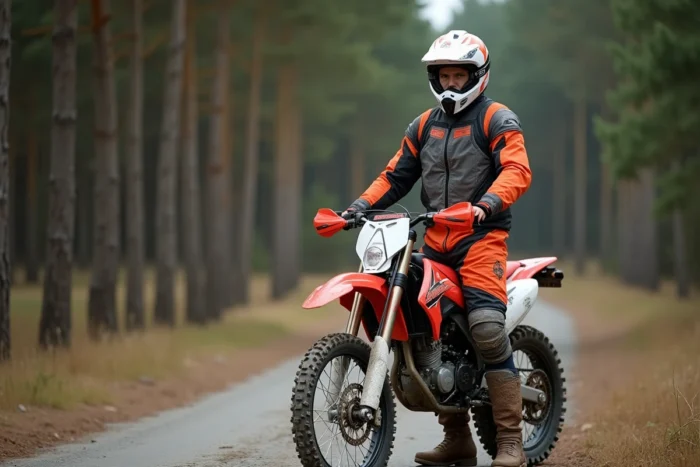
We want a 125 to tackle bumps on the weekend and return by road without loading the bike onto a trailer. The problem is that the majority of 125 motocross bikes sold in France are not street-legal: no registration document, no license plate, no possible insurance.
Before comparing engines or suspensions, you need to check one point that conditions everything else: is the homologated 125 motocross bike you are targeting actually approved for use on public roads?
EC Approval and Registration Document: The Filter Before Buying a 125 Motocross
On the ground, we regularly encounter riders who have added turn signals and a headlight to a track bike thinking it would make it legal. It doesn’t work. A motocross bike without EC approval will never be homologated, even if equipped with a complete lighting kit.
The legal criterion is binary: the bike must have received European type approval (category L3e for a 125) at the factory. It is this approval that allows for the issuance of a registration document, the installation of a license plate, and the subscription of road insurance. Without it, use remains limited to private land or closed circuits.
Before signing a check, we check three concrete elements:
- The EC approval number engraved on the manufacturer’s plate, which confirms that the model has been homologated for road use in Europe.
- The correspondence between the frame number (VIN) and the certificate of conformity provided by the seller, to ensure that the bike has not been structurally modified.
- The presence of mandatory original equipment: front and rear lights, turn signals, mirrors, horn, kickstand, and speedometer.
If any of these points are missing, we pass. A guide to choosing a homologated 125 motocross details these checks precisely to avoid unpleasant surprises at the prefecture.

2-Stroke or 4-Stroke Engine on a Homologated 125: What It Changes in Daily Use
On a track bike, the choice between 2T/4T mainly comes down to riding preference. On a homologated road 125, the practical implications are different.
A 2-stroke engine delivers its power abruptly, concentrated in a narrow RPM range. On the track, this is an advantage for riders who master the clutch. On the road, between two stretches of path, this nervousness makes the monotone riding phases (straight line, moderate speed) less comfortable. The 2-stroke also requires an oil-gas mixture and more frequent top-end maintenance.
The 4-stroke offers a more progressive power curve, easier to exploit when alternating between asphalt and trails. Maintenance focuses on oil changes and valves, with intervals generally spaced out. Feedback varies on this point depending on brands and usage intensity, but overall the 4-stroke simplifies mechanical management for mixed use.
Weight and Seat Height: Two Parameters Related to the Engine
125 two-strokes are significantly lighter than their four-stroke counterparts. This difference is directly felt on rough terrain, where every kilo counts in acceleration and direction changes.
The seat height of a homologated enduro-cross 125 often exceeds 90 cm. For someone shorter than 1.70m, putting a foot on the ground at a stop becomes complicated. It is recommended to physically sit on the bike before purchase, engine off, to assess real comfort.
Insurance and License for a Homologated 125 Motocross
Riding on the road with a homologated 125 requires an appropriate license. In France, the A1 license (available from 16 years old) or the B license supplemented by a 7-hour training course allows for the operation of a 125 cm³ motorcycle. This practical training, sometimes called “125 bridge,” includes both a closed course and road riding.
The insurance for a homologated 125 motocross is more expensive than for a classic 125 roadster. Insurers consider off-road use as an aggravated risk factor. Better rates can be obtained by declaring recreational use (and not daily) and providing proof of training or experience.
Be careful also about coverage exclusions: some policies cover the road but explicitly exclude practice on natural terrain. It is essential to read the specific conditions and, if necessary, request an extension for “recreational off-road.”
Maintenance of a Homologated 125 Motocross: Key Areas to Monitor
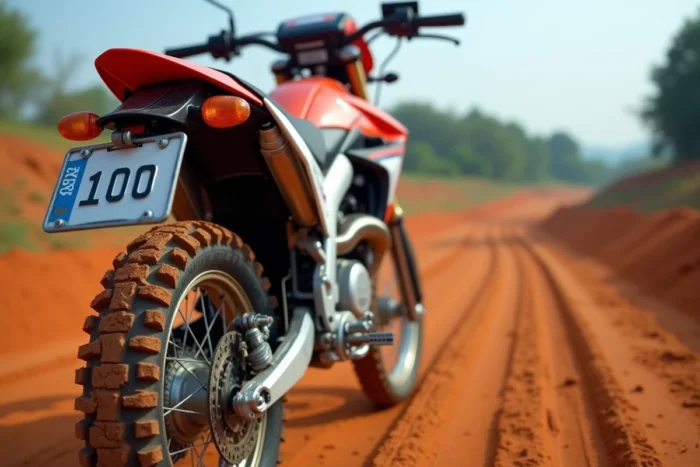
A bike used for motocross wears out faster than a 125 limited to road use. The suspensions endure repeated shocks, the chain stretches more quickly on soft ground, and the air filter collects dust with every outing.
Three maintenance areas deserve special attention:
- The air filter: to be cleaned after each off-road outing. A clogged filter reduces performance and accelerates engine wear.
- The chain and transmission kit: tension to be checked before each ride, lubrication after washing. A complete kit (sprocket, pinion, chain) is replaced as a whole when wear is advanced.
- The brake pads: braking on dirt wears the pads unevenly. Visually check the thickness every three or four outings.
Planning a significant annual maintenance budget is part of the initial choice. A homologated 125 motocross requires more maintenance than a road trail bike, and underestimating these costs can quickly turn pleasure into financial burden.
The choice of a homologated 125 motocross bike is primarily based on administrative compliance, then on the engine-use suitability, and finally on the ability to handle the regular maintenance that off-road use demands. Checking the EC approval before discussing suspension or exhaust avoids ending up with a machine unusable on the road, no matter how performant it is on the track.