Organizing an unforgettable wedding in 2024 means making choices among dozens of posts, service providers, and ceremony formats. Rather than listing decorative ideas, this article compares the major decisions that truly structure the project: ceremony format, budget allocation by category, and guest experience choices.
Wedding Budget 2024: Typical Allocation by Category and Variations by Format
The way a couple allocates their budget reveals their priorities far more than the total amount. The table below summarizes the major categories observed according to the chosen format.
| Category | Classic Wedding (proportion) | Intimate Wedding / Slow Wedding (proportion) |
|---|---|---|
| Venue | Highest share | Reduced share (unusual venue, small estate) |
| Catering / Drinks | Second category | First category (significantly higher quality per guest) |
| Floral Decoration | Significant share | Reduced in favor of local or dried plants |
| Entertainment / Guest Experience | Modest share | Growing share (360 photobooth, interactive bars) |
| Attire and Beauty | Stable | Stable |
| Photographer / Videographer | Stable | Slightly higher (long reportage, auteur film) |
In an intimate format, the budget per guest increases while the overall budget decreases. The caterer proportionally absorbs more because couples opt for a gourmet menu for a small circle.
To compare service provider offers and structure each category, the Nuptialement wedding site centralizes practical sheets detailing price ranges by category.
Civil or Religious Ceremony: What Each Format Changes in Organization
The choice of ceremony type dictates the schedule, location, and number of participants. A religious ceremony requires a place of worship, preparation with the officiant (often several months), and a fixed liturgical framework.
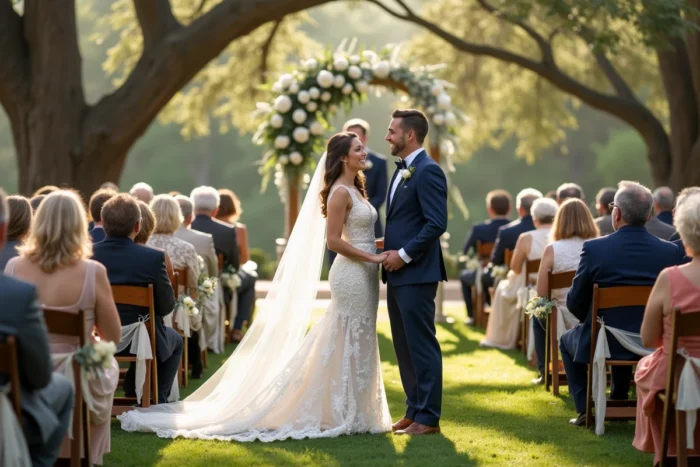
The civil ceremony offers total freedom regarding the location and proceedings. It can take place in a garden, a courtyard, or by a lake. However, it requires designing a complete script: texts, music, contributions from loved ones, order of events. Without a pre-established framework, the risk of disorganization is real if the officiant is not experienced.
Living Aisle: Rethinking Spatial Arrangement
A recent trend is to abandon the straight aisle in favor of a winding path or a semicircular arrangement around the couple. This setup, sometimes called living aisle, physically brings guests closer to the couple and alters the acoustics of the ceremony.
The logistical impact is significant: more floor space is needed, an adapted seating plan, and a sound technician capable of covering a wider area than a traditional aisle.
Slow Wedding vs. Spectacle Wedding: Two Organizational Philosophies
The slow wedding emerges as an explicit counter-trend. The idea is not to reduce the budget out of necessity but to focus every euro on what matters to the couple.
- Fewer service providers, chosen locally, using recycled or biodegradable materials for decoration
- A shorter menu but made up of locally sourced products, sometimes served in a sharing format rather than on individual plates
- Activities centered on participation (couple quiz, audio guestbook, workshops) rather than visual spectacle
In contrast, the spectacle wedding relies on the “wow” effect: 360 photobooth, videobooth, light mapping, themed cocktail stations. The guest experience becomes the primary criterion for budget allocation, sometimes even surpassing the caterer.
Neither format is objectively superior. The choice depends on the profile of the couple and their guests. A large, multigenerational family circle will react differently to an intimate wedding than a group of thirty-something friends.
Eco-Responsible Wedding Decoration: Materials and Logistics
Eco-responsibility in decoration goes beyond simply replacing fresh flowers with dried ones. It concerns the entire logistical chain.
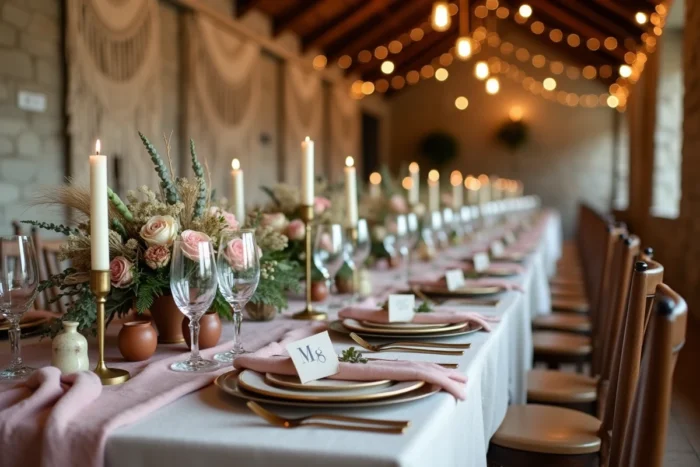
- Tablecloths and Dishware: Renting vintage or mismatched dishware is increasingly replacing disposables, even for large receptions
- Paper Supports: Seeded invitations (paper containing seeds to plant), menus printed on recycled paper, or displayed on a single support rather than individually
- Lighting: Low-consumption LED garlands instead of paraffin candles, which have a significantly higher carbon footprint
- Guest Favors: Jars of local honey, handmade soaps, seed packets, replacing traditional sugared almonds
The real ecological gain mainly depends on transportation: a venue accessible by public transport or close to guests’ homes significantly reduces the overall footprint more than the choice between fresh and dried flowers.
Personalization: How Far to Go Without Burdening the Planning
Each personalized element (monogram, custom color palette, co-constructed playlist) adds coordination time. Couples who personalize every detail often underestimate the associated mental load. A common piece of advice from wedding planners: choose three signature elements (for example: the menu, ceremony music, and guestbook) and leave the rest in standard versions.
This prioritization concentrates creative energy where it creates a memorable experience, without turning the final weeks into a logistical sprint. Three well-executed signature choices leave a stronger impression than fifteen hastily done details.
Organizing a wedding in 2024 involves balancing depth and breadth. Couples who identify their two or three priorities early on (venue, gastronomy, ceremony ambiance) build a coherent event. The format, guest list size, and degree of personalization stem from these initial choices, not the other way around.