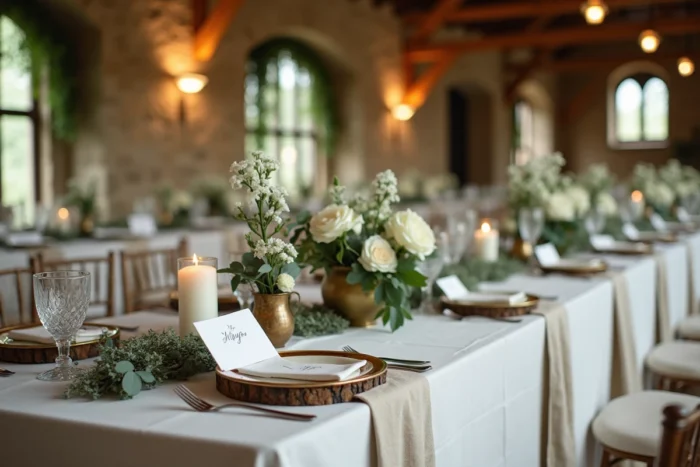
Wedding decoration in 2026 is no longer just about choosing between rustic and chic. Couples preparing their reception are looking to create a cohesive atmosphere, where every detail contributes to an overall ambiance. Current trends show a clear shift: we are moving from the accumulation of decorative objects to an approach where light, textures, and even sounds become integral components of the decor.
Lighting as the backbone of wedding decoration
Fairy lights, lanterns, and spotlights are often the last items planned for a reception. They benefit from being integrated from the design stage of the room layout. Lighting has become the most cost-effective decorative element for transforming a reception venue, regardless of its initial style.
The principle relies on modulating the color temperature throughout the evening. During dinner, warm and dim tones create an intimate atmosphere conducive to table conversations. When the dance floor opens, slightly brighter and more colorful lighting takes over.
Adjustable temperature spotlights, lanterns arranged in clusters, and filament string lights allow for structuring the space without additional furniture. A bare ceiling becomes spectacular with a network of crossed string lights. Any garden transforms into a romantic setting with lanterns hanging from branches. Those who wish to discover decor on Mariage et Décoration will find concrete examples of lighting scenarios suitable for different types of venues.
The practical advantage is real: investing in lighting often costs less than multiplying floral arrangements, and the visual effect on wedding photos is more pronounced than with most table elements.
Minimalist floral decoration: the choice of a single-flower bouquet
The 2026 trend in wedding flowers moves away from abundant compositions. Single-flower bouquets prioritize texture and repetition over variety. A centerpiece made solely of white ranunculus or dahlias in a single shade creates a graphic effect that multicolored mixes do not allow.
This structured minimalism does not mean visual poverty. The key lies in working with volumes and containers. The same type of flower displayed in vases of different heights, grouped in odd numbers on the table, creates an elegant scene without apparent effort.
- Choosing a single variety of flower simplifies logistics with the florist and reduces the risk of discrepancies between the order and the final result
- The repetition of a unique floral pattern throughout the venue (tables, ceremony arch, reception) reinforces the visual coherence of the overall decoration
- Single-flower compositions lend themselves better to subdued color palettes, which remain dominant in elegant weddings (off-white, sage green, terracotta)
Some couples find single-flower arrangements too austere for a celebration. The middle-ground solution is to vary the textures of foliage around a single floral species, which adds movement without breaking the unity.
Sensory corners: replacing the photobooth with an experience
The photobooth with cardboard props has had its time. Weddings in 2026 are seeing the emergence of sensory corners that engage guests beyond the visual. A fragrance bar where each guest creates a scented memory of the wedding. A tactile wall of materials (velvet, linen, raw wood) that serves both as decor and entertainment. A calligraphy corner where guests write their wishes on textured paper.
These installations serve a dual purpose. They occupy downtime between the highlights of the reception, and they constitute decorative elements in their own right when not in use.
Ambient sound is also part of the decoration. Acoustic musicians providing background music during the cocktail hour, a carefully curated playlist during the meal: the sound atmosphere influences the perception of space as much as colors or flowers do. Treating sound as a decorative element is to acknowledge that the elegance of a wedding encompasses all the senses.
Color palette and wedding theme: the trap of overload
Choosing a theme (bohemian, vintage, rustic chic) and then applying it to every element is a common method. The main risk is visual saturation: when everything, from the menu to the chair ribbon, repeats the same pattern, the overall effect loses subtlety.
A more effective approach is to limit the palette to two or three colors maximum and to leave some elements neutral. A plain white tablecloth, for example, serves as a visual breather between more elaborate table elements.
- Choosing a dominant color, an accent color, and a neutral (white, cream, or light gray) is enough to create a readable visual identity
- Elements made from natural materials (wood, linen, wicker) work as neutrals and integrate into most themes without being overbearing
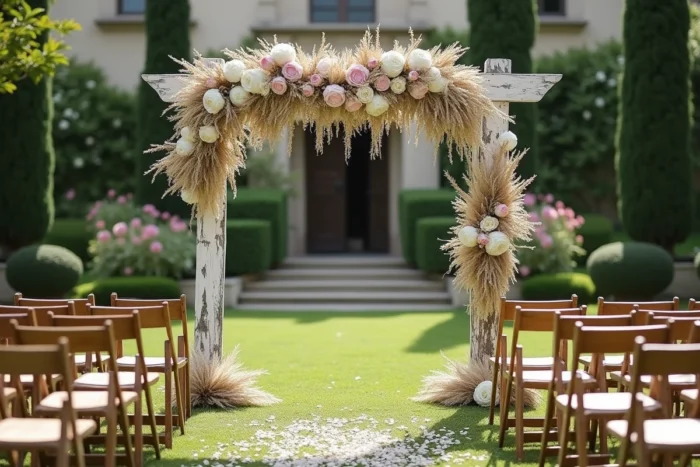
- Reserving the strong theme for two or three focal points (the ceremony arch, the centerpiece, the entrance to the room) rather than spreading it everywhere avoids a catalog effect
The rustic chic wedding, for example, gains elegance when the “rustic” aspect focuses on the venue and foliage, while the tableware and glassware remain simple and refined. It is the controlled contrast between registers that produces elegance, not uniformity.
The most successful personalization rarely comes from objects specifically purchased for the occasion. A family fabric used as a table runner, a collection of mismatched candles found over the months, handwritten labels rather than printed ones: these choices tell a story that standardized decorations cannot convey. A reception venue transformed by objects with their own history remains memorable long after the last dance.