
The market for electric hedge trimmers has become denser in recent years, with ranges increasingly resembling each other on paper. Power, blade length, weight: the technical specifications align comparable data from one brand to another. Choosing an electric hedge trimmer suitable for one’s garden requires looking beyond these basic specifications, incorporating criteria that traditional guides rarely address.
Vibrations and joint fatigue: the overlooked criterion of electric hedge trimmers
Most comparisons focus on power and cutting length. Field feedback diverges on this point: a powerful model but heavily vibrating tires out the wrists and forearms much faster than a slightly less powerful device equipped with a damping system in the handles.
According to tests published by Jardinage-Media in June 2026, electric hedge trimmers designed to reduce vibrations transmitted to the joints are significantly less tiring during prolonged sessions. Sharper blades, progressive clutches, and cushioned handles make up the technical triptych of these models.
For a gardener trimming several dozen linear meters of hedge, this parameter weighs more than a few extra watts. The detailed specifications available on taille-haie-electrique.com allow for comparing models based on these types of technical characteristics, beyond just power figures.
The prevention of musculoskeletal disorders is not trivial. Trimming a hedge generates repeated shocks in the branches, and the stresses accumulate from one session to the next. Prioritizing an ergonomic device also preserves one’s ability to garden over the long term.

Battery or corded: how the ecosystem of garden tools changes things
The choice between a corded hedge trimmer and a battery model is not limited to the question of an extension cord. In recent years, manufacturers have structured their ranges around interchangeable battery platforms. The same battery powers the hedge trimmer, the lawn mower, the blower, and the pruning chainsaw.
This ecosystem system alters the economic calculation. Buying a first battery tool is more expensive than a corded model, as the price includes the charger and battery pack. However, each additional tool in the same ecosystem can be purchased in a “bare” version (without battery), which reduces the unit cost.
The concrete limits of battery for hedge trimming
Battery life remains the main point of vigilance. On a cordless electric hedge trimmer, a standard battery allows for trimming between one and several dozen meters of hedge depending on the thickness of the branches and the capacity of the pack. Dense hedges of hardwood consume much more energy than hedges of privet or laurel.
The safety of lithium-ion batteries is also receiving increased attention. As noted by Le Devoir, safety regulations struggle to keep pace with the rise of these batteries, particularly regarding storage and transport. A point to keep in mind for the winter storage of the tool in a garage or garden shed.
- Check the compatibility of the battery with other tools of the same brand before purchasing, to avoid multiplying chargers and formats.
- Store batteries away from frost and excessive heat, in a ventilated area, outside of usage periods.
- Prefer a model whose battery offers a readable charge indicator during work, to anticipate recharging.
Hedge trimming regulations: a constraint that conditions the choice of tool
The choice of an electric hedge trimmer cannot ignore the regulatory trimming calendar. In France, a ban on hedge trimming runs from early April to mid-August as part of the CAP (Common Agricultural Policy), to protect bird nesting. This rule, recalled by L’Ami des Jardins in June 2026, primarily concerns agricultural operators but also influences the practices of individuals in rural and peri-urban areas.
In practical terms, this means that intensive trimming is concentrated in two windows: late winter (February-March) and late summer (from mid-August). These periods correspond to very different vegetation conditions.
Adapting the model to the trimming period
At the end of winter, the branches are dry and brittle. An electric hedge trimmer with a wide tooth spacing is better suited to absorb semi-woody branches without blocking the blade. At the end of summer, the vegetation is in full sap, soft and dense: a double-action blade with a fine cut provides a cleaner result on this type of growth.
Local noise regulations add another layer. Several municipalities limit the use of motorized gardening tools to certain time slots, often in the morning on weekdays and a few hours on Saturday. An electric hedge trimmer (corded or battery) produces a sound level significantly lower than a thermal model, which offers more flexibility in adhering to these time slots.
Blade length and tooth spacing: two parameters linked to the type of hedge
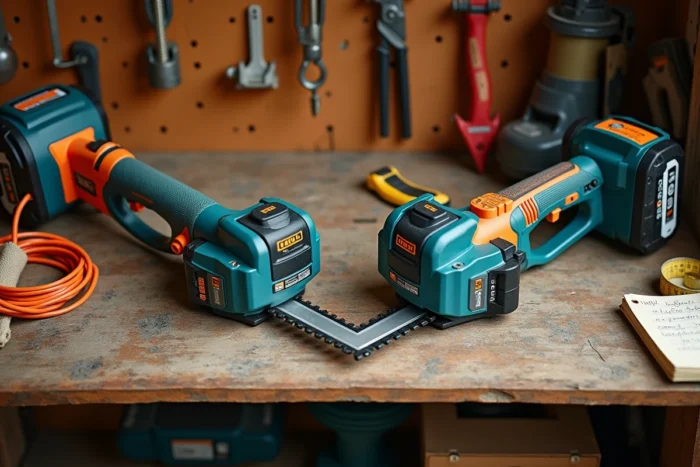
The blade length determines the cutting width in a single pass. For a low and narrow hedge (boxwood, lavender), a short blade is sufficient and offers better maneuverability. For a wild hedge several meters high, a longer blade reduces the number of passes and fatigue.
The tooth spacing, on the other hand, determines the maximum diameter of branches that the tool can cut. The available data do not allow for setting a universal threshold: it all depends on the plant species. A hornbeam or beech produces harder branches than a thuja, at equivalent diameter.
- Conifer hedge (thuja, Leyland cypress): a moderate tooth spacing is sufficient, the cut is clean on tender shoots.
- Wild hedge (hornbeam, hazel, hawthorn): plan for wider spacing and sufficient motor power for semi-woody branches.
- Boxwood or topiary hedge: prefer a short and precise blade, with a contained weight to work at arm’s height without fatigue.
The total weight of the device remains a determining factor for any trimming at height. An outstretched arm hedge trimmer feels twice as heavy than in a low position. Models on a telescopic pole partially solve this problem but add a lever effect that strains the shoulders.
Choosing an electric hedge trimmer means crossing these technical parameters with the reality of one’s garden: type of hedge, linear footage to maintain, trimming frequency, sensitivity to vibrations. A device adapted to these specific constraints will make each trimming session more efficient and less taxing than a model chosen solely based on a power ranking.