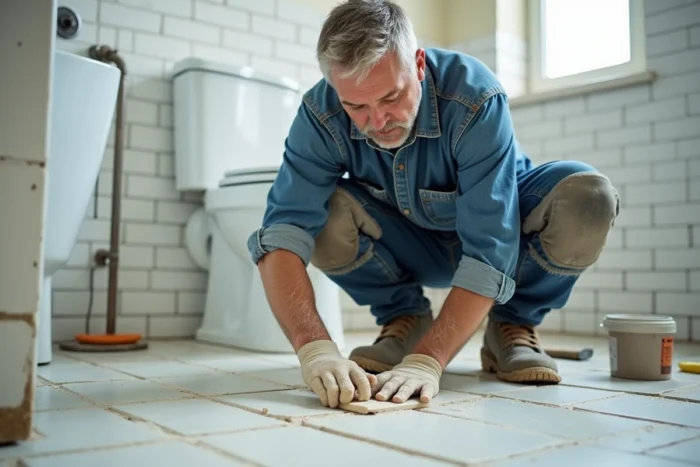
On a renovation site, we often end up underestimating the time it takes to grout tiles. The laying of the tiles goes quickly, then everything slows down at the grouting stage. To accurately estimate this delay, it is necessary to distinguish between the actual working time, the drying of the mortar, and the time before the room can be fully used again.
Drying time of the adhesive before starting the grouting
You do not grout freshly laid tiles. The adhesive must have hardened sufficiently so that the tiles do not move under the pressure of the squeegee or sponge. In practice, we generally wait at least a full day after the laying is completed.
To know how long it takes to grout tiles, one must also consider the conditions of the site. A cold or damp room extends the hardening of the adhesive, sometimes significantly. In a bathroom without proper ventilation or on a poorly heated winter site, it is better to count on two days before touching the grout.
The substrate also plays a role. On a recent cement screed, residual moisture can delay the setting. On an old tiled surface, the adhesive generally sets more quickly because the substrate is stable and dry.
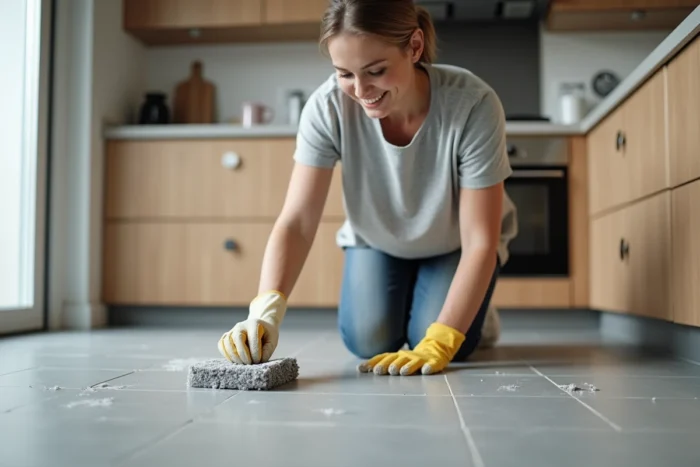
Actual grouting duration depending on the surface and type of tiles
The pure working time depends on three concrete factors: the surface to be covered, the size of the tiles, and the width of the joints.
- Small format tiles (such as mosaic or cement tiles) multiply the linear footage of joints. It easily takes double the time per square meter compared to large format tiles.
- The width of the joint changes the amount of mortar to prepare and smooth. A wide joint requires more passes with the squeegee and more meticulous cleaning.
- A floor is grouted faster than a wall because you work flat and the mortar does not run. On a wall, you work in small areas to prevent the product from drying before smoothing.
For a medium-sized room with standard tiles, the actual grouting takes between half a day and a full day. On a large porcelain stoneware floor with thin joints, it can go faster. On a backsplash with small tiles and wide joints, the same work takes proportionally much longer.
Cement mortar or epoxy grout: a very different site schedule
The choice of grout mortar not only changes the technique but also the schedule of the site. There are two main families.
Classic cement grout
This is the most common product. It is mixed with water, applied with a rubber squeegee, and then cleaned with a damp sponge before the cement sets. The cleaning must occur within minutes after application, otherwise a whitish film settles on the tiles and becomes difficult to remove.
After application, a CG2 type cement mortar can be walked on after about a day at room temperature. However, strong exposure to water (daily shower, terrace exposed to rain) should only occur after one to two weeks. This point is often overlooked: the bathroom may seem finished, but the full strength of the cement grout requires several additional days of drying.
Epoxy grout: faster to harden, more demanding to apply
Epoxy grouts offer superior resistance to water and stains, making them suitable for humid areas and countertops. Their curing time is generally shorter than that of cement mortar.
The open time (the window during which you can work with the product) is very limited. Small quantities are prepared, grouting is done in areas of a few square meters, and immediate cleaning is required.
The organization of the site must be meticulous to avoid wasting product. Feedback varies on this point, but most tilers agree that epoxy grout requires more effective working time per square meter than cement grout, despite faster drying.
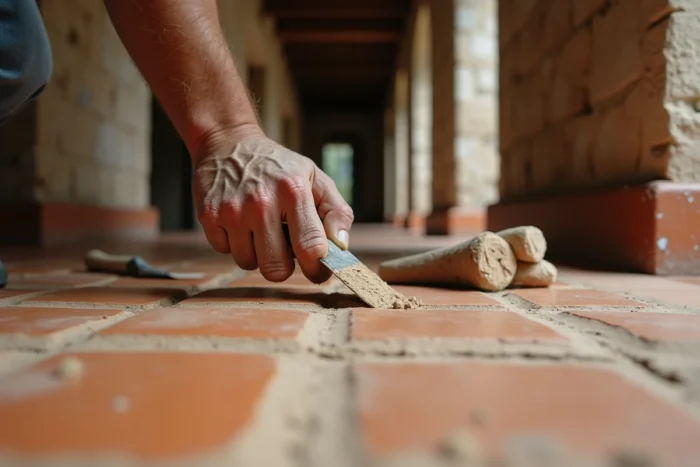
Cleaning and putting the tiles back into service after grouting
Grouting does not stop with the last stroke of the squeegee. Cleaning is an integral part of the time to be planned.
A first pass with a sponge is done immediately after application to remove excess mortar from the surface of the tiles. A second, more careful cleaning occurs a few hours later, once the grout has started to set. On a floor, it is best to avoid walking on the fresh joints during this phase.
The cement film that sometimes remains after drying requires a diluted acidic product suitable for the type of tile. On porcelain stoneware, it’s simple. On natural stone or porous cement tiles, acidic cleaning is to be avoided, which requires more rigorous sponge work right from the laying.
In summary, for a complete project in a house:
- Waiting after laying the tiles before grouting: a minimum of one day, more in cold or damp conditions.
- Grouting and cleaning a standard room: half a day to a full day of work.
- Drying before light foot traffic: about one day.
- Delay before exposure to regular water (shower, terrace): one to two weeks for cement mortar.
The total time between the end of the laying and the normal use of the room is therefore counted in days for a dry floor, and in weeks for a wet room. Planning this delay from the start avoids unpleasant surprises, especially when coordinating multiple trades on the same site.