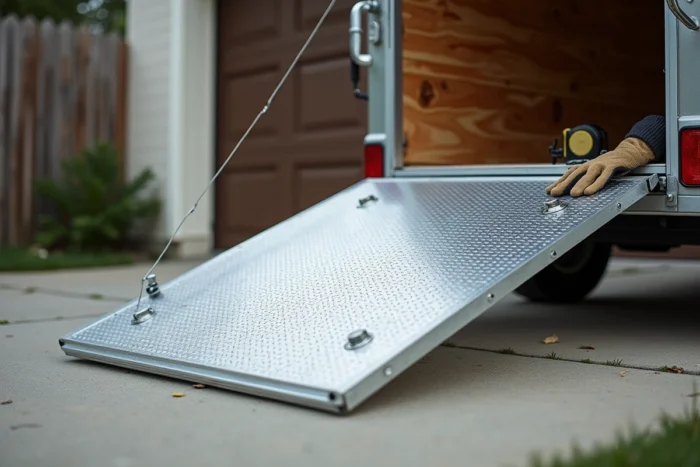
A loading ramp for trailers is an inclined plane that attaches between the ground and the vehicle’s floor to load or unload a wheeled machine: motorcycle, riding mower, mini-excavator, quad. The choice of material, length, and fastening system determines both the safety of the operation and the lifespan of the equipment.
Galvanized steel vs aluminum: the real criteria for choosing a trailer ramp
The ramps sold in DIY stores are mostly made of galvanized steel. This treatment protects the metal from corrosion with a layer of zinc, making it suitable for outdoor storage or in a damp garage. The compromise lies in the weight: a pair of steel ramps weighs significantly more than an equivalent aluminum pair, making it difficult for one person to handle.
Aluminum, on the other hand, offers a much more favorable strength-to-weight ratio. In recent years, folding aluminum ramps with a non-slip surface have become a standard in the market for loading motorcycles and mowers onto trailers. Their price remains higher than that of steel, sometimes double for an equivalent capacity.
For occasional use (a few loadings per year), galvanized steel performs its role without difficulty. However, for those who regularly load a motorcycle or garden equipment, foldable aluminum reduces fatigue and the risk of awkward movements when setting up the ramp. A detailed comparison on the Brico Dépôt loading ramp for trailers allows for a comparison of the technical characteristics of the models available in stores.
Length, width, and load capacity: the important dimensions
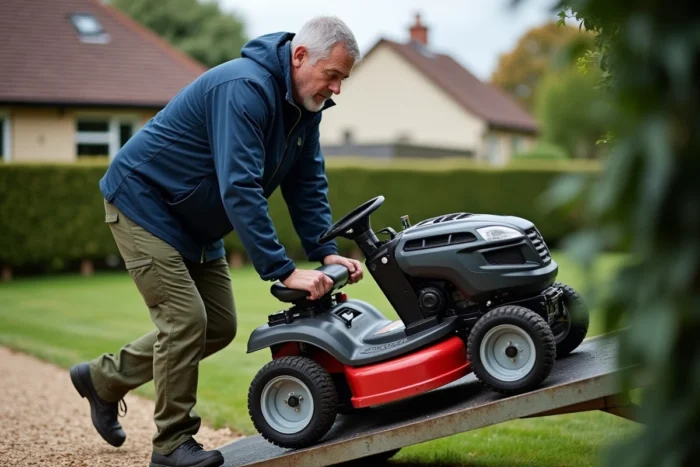
The length of the ramp determines the angle of inclination. The shorter the ramp is in relation to the height of the trailer’s floor, the steeper the slope will be. A slope that is too steep presents two concrete problems: the drive wheel slips during ascent, and the undercarriage or exhaust pipe risks scraping at the pivot point between the ramp and the ground.
Width and lateral stability
The standard width of models from large retailers is around twenty centimeters per ramp. This is sufficient for the wheel of a motorcycle or quad, but it leaves very little margin for lateral error. User feedback indicates that below this width, the slightest deviation in trajectory causes the wheel to fall off the ramp.
For a wider machine (riding mower, mini-dumper), a full-width single ramp offers more safety than a pair of narrow rails.
Declared load capacity
The displayed capacity corresponds to a uniformly distributed static load. In real situations, a machine going up generates a dynamic load concentrated at a point. This means that one should always allow a margin compared to the weight of the machine being loaded. If the motorcycle weighs slightly less than the ramp’s maximum capacity, the safety margin is insufficient.
- Check the maximum load capacity indicated on the label and compare it to the actual weight of the machine, including equipment
- Prefer a ramp whose capacity exceeds the weight of the machine to be loaded by at least one third
- Ensure that the fastening (hook, lip) is suitable for the edge of the trailer’s floor
Fastening and safety: points that product sheets do not detail
Most entry-level ramps have a simple bent lip that hooks onto the edge of the floor. This system works as long as the edge is straight and the trailer does not move. The problem arises when the trailer is not stabilized: under the load’s effort, it rolls back, the lip slips, and the ramp falls.
Stabilizing the trailer before placing the ramp is the first safety measure. This involves chocking the trailer’s wheels or even leaving the towing vehicle hitched with the handbrake engaged. These precautions may seem basic, but field reports show that most loading incidents stem from an unstabilized trailer.
Non-slip surface and grip
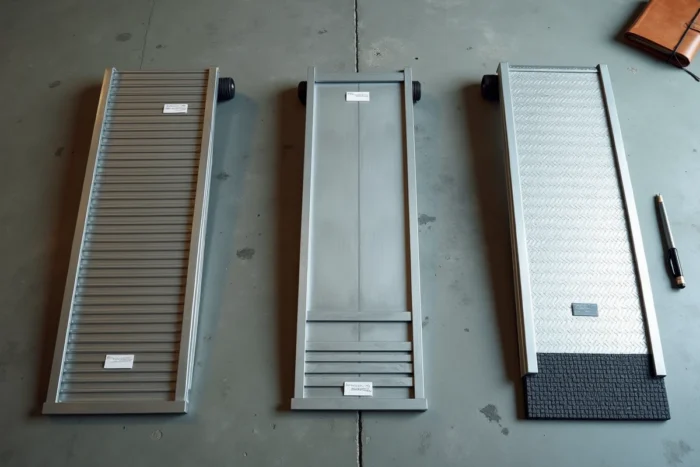
Low-end galvanized steel ramps have a smooth or barely textured surface. In wet weather, the friction coefficient drops, and a motorcycle wheel can slip even on a moderate slope. Models with perforations or an added non-slip coating offer superior grip.
Recent aluminum ramps often incorporate cross grooves directly formed into the profile. This manufacturing detail makes a real difference when manually pushing a heavy machine up the ramp.
User reviews on Brico Dépôt ramps: the most common feedback
Feedback published on specialized motorcycle and trailer forums converges on several points. The value for money of galvanized steel models is generally praised: for a modest budget, the pair of ramps fulfills its function for occasional use. Galvanization lasts over time if the ramps are not stored permanently in a saline environment.
Critiques focus on two recurring aspects:
- The width deemed just right for the wide tires of certain trails or customs
- The weight of the pair in steel, difficult to handle alone in a parking lot or roadside
- The lack of a marked non-slip surface on entry-level models
For users who regularly load a motorcycle, switching to a foldable aluminum ramp with side edges appears to be an investment that pays off from the first year of frequent use. The initial extra cost is offset by the time saved and the reduced risk of the machine falling during ascent.
The final choice mainly depends on the frequency of use and the weight of the machine. A galvanized steel ramp remains relevant for a few annual loadings of a lightweight mower. As soon as the weight of the machine increases or the handling is repeated, foldable aluminum with integrated grip becomes the best compromise between safety, practicality, and longevity.