Standard Jamaican English functions as the de facto official language in Jamaica, without any constitutional text explicitly establishing it. This situation, inherited from the British colonial period, coexists with Jamaican Creole spoken by the majority of the population in daily exchanges. Understanding this duality requires examining the linguistic mechanisms, standardization issues, and political dynamics that structure the linguistic landscape of the island.
Orthographic Standardization of Jamaican Patois: An Ongoing Technical Project
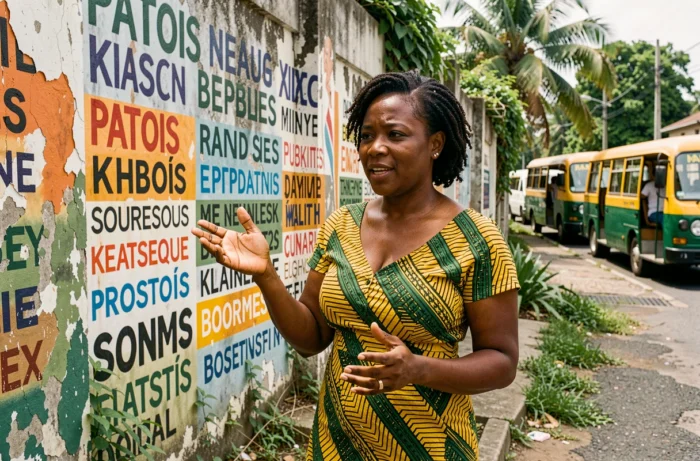
Jamaican Creole, locally known as patwa, still lacks a unified and stabilized orthography. Academic work, particularly at the University of the West Indies, has been attempting for several decades to formalize a coherent writing system. The difficulty lies in the very nature of the creole: its phonology significantly diverges from standard English, and speakers fluctuate between Anglicized spellings and phonetic transcriptions.
Normalization efforts encounter a recurring obstacle. The lack of consensus on spelling hinders the use of patwa in formal writing, whether in administration, the press, or educational publishing. As of 2026, codification initiatives remain active, but no national linguistic authority has imposed a binding graphic standard.
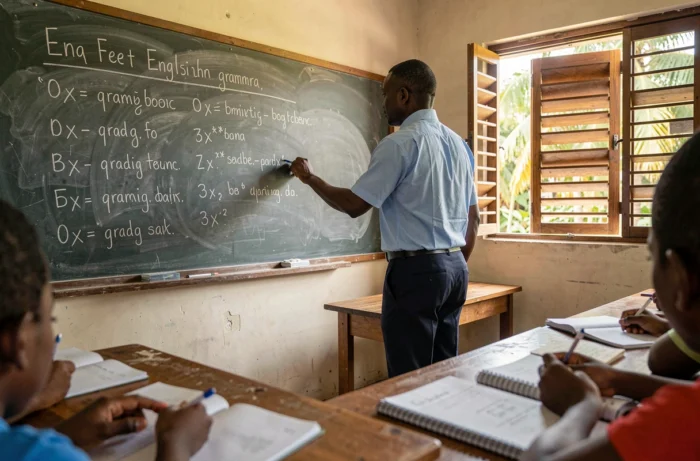
This uncertainty has concrete consequences in the educational field. Some teachers advocate for patwa to be used to convey the basics of learning before transitioning to English, as reported by several Jamaican sources. Without a reference spelling, the production of school textbooks in Creole remains artisanal.
We observe that the official language of Jamaica thus retains an ambiguous status, as English dominates institutional writing by default, due to the lack of a standardized competitor.
De Facto Status of Jamaican English: Why No Law Decides
Jamaica has never enshrined English as the official language in its Constitution. This legal vacuum, inherited from independence in 1962, persists because it suits both sides of the linguistic debate. Proponents of English do not need a text: the language already dominates the state apparatus, the judicial system, formal education, and written media. Advocates of patwa, on the other hand, prefer the absence of constitutional locking, which leaves the door open for future co-officialization.
Standard Jamaican English is not British English. It incorporates lexical, syntactic, and prosodic peculiarities unique to the island. Pronunciation diverges on several points (reduction of certain diphthongs, treatment of “th”), and vocabulary borrows from Creole, Spanish, and West African languages of the populations deported during the slave trade.
The legal debate has resurfaced in recent years, particularly when Jamaican intellectuals used the New York Times as a platform to advocate for the recognition of patwa. Writers, filmmakers, and researchers have pointed out that more than half of the population is more proficient in Creole than in English, which raises issues of access to public services and justice.
Jamaican Creole in the Political Sphere: From Informal Discourse to Electoral Manifesto
Patwa has long been confined to private conversations, markets, and music. Its emergence in formal political communication marks a turning point. In 2025, the People’s National Party (PNP) released an audio version of its electoral manifesto in Jamaican patois, an unprecedented gesture in the country’s institutional life.
This choice goes beyond symbolism. It implicitly acknowledges that standard English is insufficient to reach the entire electorate. For a significant portion of the population, understanding a political text in formal English remains approximate. Patwa thus becomes a vector of democratic inclusion, not just an identity marker.
Persistent Asymmetry Between English and Patwa
The perception of bilingualism in Jamaica remains deeply unbalanced. English suffices for work, dealing with administration, and accessing banking or legal services. Patwa, however, remains essential in informal interactions, family exchanges, and community life. A monolingual Jamaican in patwa faces a structural disadvantage against the English-speaking administrative apparatus.
A report cited by the Jamaican press revealed that a notable proportion of students entering secondary school did not master reading in English. This finding fuels the demand for bilingual education, where Creole would serve as a bridge language before transitioning to academic English.
Colonial Legacy and Linguistic Substrates: What Patwa Owes to West Africa
Jamaican Creole formed on sugar plantations, through forced contact between the languages of enslaved people (akan, igbo, yoruba) and the English of the colonizers. This genesis explains several structural traits of patwa that are not found in standard English:
- The simplified pronoun system, without gender distinction (“im” for he/she/it), modeled on West African languages where the pronoun carries no gender marking
- Conjugation by preverbal particles (“did” for the past, “a go” for the future) rather than by verb inflection, a mechanism absent from English but common in Kwa languages
- Expressive reduplication (“nuff nuff” for “very many”), a productive process in several Niger-Congo languages
Patwa is not a degraded form of English but an autonomous linguistic system, with its own grammar, distinct phonology, and lexical formation rules. Creole linguists classify Jamaican among the Atlantic creoles based on English, alongside Suriname’s sranan tongo or Sierra Leone’s krio.
Linguistic Continuum and Code-Switching
The sociolinguistic reality in Jamaica cannot be reduced to a binary opposition of English/Creole. Speakers navigate a continuum ranging from basilect (the creole most distant from English) to acrolect (standard English), passing through intermediate varieties known as mesolects. The shift from one register to another depends on the context: court, job interview, conversation among friends, religious preaching.
This permanent code-switching makes the boundary between the two languages porous. The same speaker may start a sentence in standard English and finish it in patwa without it being perceived as a rupture. This fluidity complicates any attempt at a decisive language policy, as the population itself does not view the two codes as foreign to each other.
The linguistic trajectory of Jamaica remains suspended between two logics: that of an official English that structures institutions without a legal text, and that of a majority creole whose written normalization progresses slowly. The PNP manifesto in patwa and the debates on bilingual education show that the issue is no longer cultural but functional, related to concrete access to rights and knowledge.